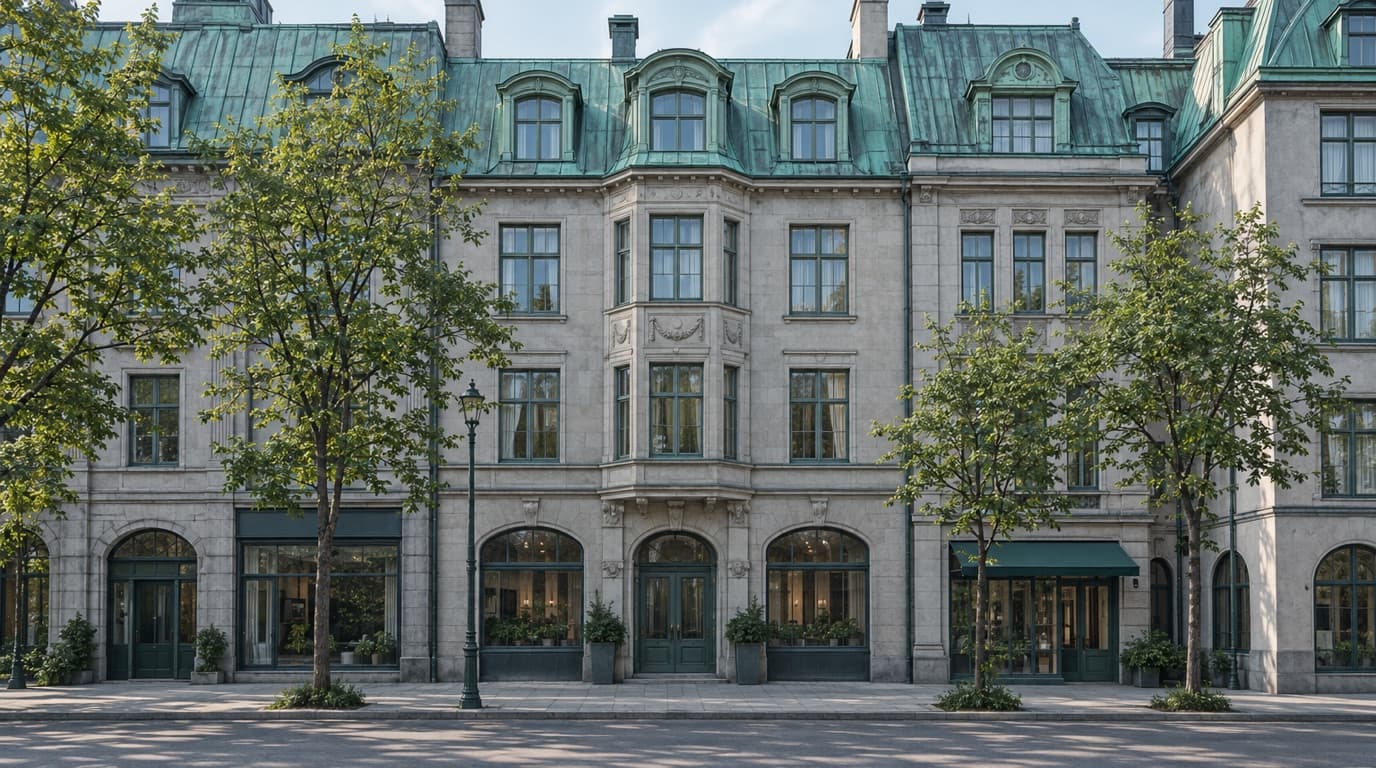
Where should your office be in Stockholm? The choice is usually between an office on Södermalm, in the City, on Östermalm, Kungsholmen or Vasastan, or in an office cluster such as Hagastaden, Solna, Kista or Hammarby Sjöstad. The areas differ clearly in rent level, transport links and the kinds of companies that thrive there. This guide goes through each area: character, typical tenants, transport links and relative price level.
Price levels: how do the areas compare?
Brokers divide the Stockholm office market into three price tiers. According to Cushman & Wakefield's MarketBeat for the second quarter of 2026, prime rents are:
| Submarket | Example areas | Prime rent (SEK/sqm/year) | Vacancy |
|---|---|---|---|
| CBD | Central Norrmalm, southern Östermalm | 9,850 | 8% |
| City Centre | Södermalm, Kungsholmen, Vasastan, rest of the inner city | 6,200 | 14% |
| Decentralised | Solna, Sundbyberg, Kista, Hammarby Sjöstad | 4,100 | 23% |
The mapping of areas in the table is simplified. Prime rents apply to the best space, and the range within each area is wide. More on rents and what is included in our overview of what it costs to rent an office in Stockholm.
Södermalm: renting an office on Söder
Character: Södermalm is the creative part of the inner city. Offices are often in older stone buildings, former industrial and workshop spaces or street-level units with their own entrance, mixed with newer office buildings around Slussen and Medborgarplatsen. An office on Södermalm puts street life, restaurants and cafés around the corner.
Typical tenants: Advertising and design agencies, media companies, tech companies and startups, architects and smaller consultancies. Many look for 50 to 500 sqm.
Transport: The red and green metro lines (Slussen, Mariatorget, Zinkensdamm, Hornstull, Medborgarplatsen, Skanstull) and commuter rail at Stockholms södra. Close to the City without City prices.
Price level: Inner-city level, below the CBD. Spaces near Slussen and in newer buildings are at the top.
City, Norrmalm and the CBD
CBD stands for Central Business District and is the brokers' name for Stockholm's most expensive office location: central Norrmalm and southern Östermalm, roughly the area between Central Station, Hötorget and Stureplan. The exact boundary varies between brokerage firms.
Character: Stockholm's business centre around Sergels torg, Hötorget, Norrmalmstorg and Klarakvarteren. Dense, prestigious and with a large share of modernised and new offices.
Typical tenants: Banks, law firms, audit and consulting firms, international headquarters and growing tech companies that want visibility.
Transport: The best in Sweden. T-Centralen is the hub for every metro line, Stockholm City and Central Station have commuter and intercity trains, and the Arlanda Express leaves from here.
Price level: The highest in Stockholm. JLL reports that top CBD deals have reached SEK 12,000/sqm/year, while the median lease was SEK 8,200/sqm/year (JLL, February 2026).
Östermalm
Character: Elegant and exclusive, with turn-of-the-century buildings, office floors with tiled stoves and stucco, and proximity to Stureplan. Southern Östermalm is part of the CBD.
Typical tenants: Private equity and finance firms, law firms, family offices, communications agencies and consultants who want a prestigious address.
Transport: The red line (Östermalmstorg, Karlaplan, Stadion, Tekniska högskolan) and walking distance to the City.
Price level: High around Stureplan and in southern Östermalm, somewhat lower further north and east.
Kungsholmen
Character: Calmer than the City but just as close. Eastern Kungsholmen has government agencies and courts, while Western Kungsholmen around Lindhagen and Marieberg has grown into a modern office area with newer waterfront buildings. According to Cushman & Wakefield, Telenor signed one of the larger leases of the second quarter of 2026 in Western Kungsholmen.
Typical tenants: Mid-sized companies, government agencies, media and telecom companies, consultants.
Transport: The blue line (Rådhuset, Fridhemsplan, Stadshagen), the green line at Fridhemsplan and many bus routes. Close to Central Station.
Price level: Inner-city level. The new buildings in Western Kungsholmen are priced above older stock.
Vasastan
Character: A residential part of the inner city with plenty of restaurants and services. Offices are often in older buildings, at street level and on upper floors, which suits smaller companies.
Typical tenants: Agencies, tech companies, consultants and smaller companies that want a central address without City prices.
Transport: Odenplan with the green line and commuter rail, plus S:t Eriksplan and Rådmansgatan. The new yellow metro line between Odenplan and Arenastaden, via Hagastaden, is under construction.
Price level: Inner-city level, often somewhat lower than Norrmalm.
Hagastaden
Character: A new district being built over and around former rail yards between Vasastan and Solna, with Karolinska Institutet and the New Karolinska Solna hospital as neighbours. Lots of new construction and a growing life science cluster.
Typical tenants: Life science, research, medtech and, more recently, large tech and telecom companies. Cushman & Wakefield reports that Ericsson signed two large leases in Hagastaden in the second quarter of 2026, totalling almost 100,000 sqm.
Transport: Commuter rail and metro at Odenplan, and an upcoming station on the yellow line.
Price level: Rising. JLL reports that rent in Hagastaden rose to SEK 5,800/sqm/year in the second quarter of 2026, up 9.4 percent in a single quarter (JLL, Q2 2026).
Kista
Character: Kista Science City is an established tech cluster with large, modern office buildings and plenty of space. Kista has long been shaped by Ericsson and other IT and telecom companies.
Typical tenants: IT, telecom, tech companies, research-related businesses and companies that need large spaces at lower rents.
Transport: The blue line to the City in well under half an hour, close to the E4 and E18 and relatively close to Arlanda.
Price level: Lower than the inner city. Vacancy is high: JLL reports 36 percent in Kista in the second quarter of 2026, which gives tenants a strong negotiating position.
Solna and Sundbyberg
Character: Solna has grown into one of Stockholm's largest office areas, with clusters such as Arenastaden, Frösunda, Hagalund and Solna strand. Sundbyberg has a dense town centre with newer office buildings around the station.
Typical tenants: Headquarters of large Swedish and international companies, as well as mid-sized companies that want modern space close to the City at lower rents.
Transport: Commuter rail (Solna, Sundbyberg), the blue line, the cross-town light rail (Tvärbanan) and close to the E4. Arenastaden will get a station on the yellow line.
Price level: Below the inner city and often on a par with or above other outer areas, depending on location and building.
Hammarby Sjöstad and Slakthusområdet
Character: Hammarby Sjöstad is a former industrial and harbour area that has become a waterfront district mixing homes and offices. Next to it is Slakthusområdet by the Globe arenas, where the City of Stockholm is turning an old industrial area into a new district with offices, homes, culture and restaurants.
Typical tenants: Tech and media companies, creative agencies and companies that want a modern office close to Södermalm.
Transport: Tvärbanan light rail, the green line (Skanstull, Gullmarsplan, Globen, Skärmarbrink) and close to the Södra länken motorway.
Price level: Outer-area level up to the lower end of the inner city. New builds in Slakthusområdet may be higher.
How to choose an area
Start with three questions: Where do your people live? What is your budget per workstation? How important is the address for clients and recruitment? Then draw a travel-time map from your people's homes and compare it with the price levels above. The next steps are covered in our guide to renting an office in Stockholm.
Frequently asked questions
How much does it cost to rent an office on Södermalm?
Södermalm counts as the inner city, where Cushman & Wakefield puts prime rent at around SEK 6,200/sqm/year (Q2 2026). Many spaces, especially in older buildings, are let below that level. New offices near Slussen are higher.
What is the CBD in Stockholm?
The CBD, Central Business District, is the most central and most expensive part of the office market: central Norrmalm and southern Östermalm around Stureplan. According to Cushman & Wakefield, prime rent there was SEK 9,850/sqm/year and vacancy 8 percent in the second quarter of 2026.
What is the most expensive area to rent an office in Stockholm?
The CBD, meaning central Norrmalm and southern Östermalm around Stureplan. Prime rent was SEK 9,850/sqm/year according to Cushman & Wakefield, and top deals reached SEK 12,000/sqm/year according to JLL.
Where is it cheapest to rent an office in Stockholm?
In outer areas such as Kista, Solna, Sundbyberg and parts of the southern suburbs. Prime rent there was around SEK 4,100/sqm/year according to Cushman & Wakefield, and vacancy is higher, which leaves room to negotiate.
Which area suits a startup best?
Many startups choose Södermalm, Vasastan or a serviced or flexible office in the City to be close to other companies and talent. If you need a lot of space at low cost, Kista, Solna or Hammarby Sjöstad are worth a look.
Find an office in the right area
Do you know which area you want, or would you like to compare several? Shace searches the whole market and sends a handpicked shortlist within 24 hours. Tell us what you need and we will match you with the right office.