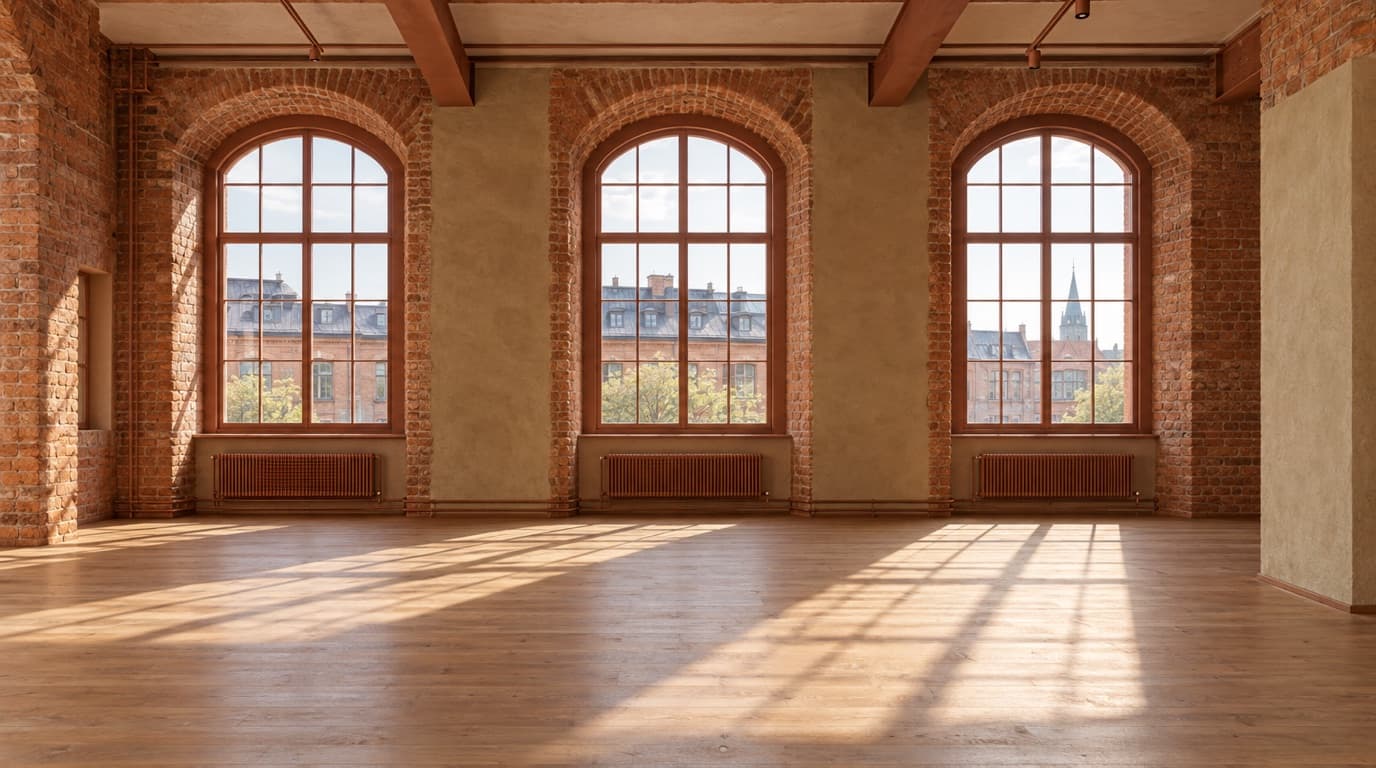
Letting commercial premises takes more than setting a rent and posting an ad. To let an office or other commercial space in Sweden you need a rent the market will accept, a commercial lease that complies with Chapter 12 of the Land Code (jordabalken), a decision on VAT, an agreement on tenant fit-outs, and a tenant who can pay for the full lease term. This guide walks property owners through the steps of letting office space.
Letting commercial premises: step by step
- Prepare the premises: measure the area, produce a floor plan and check that the building has a valid energy performance certificate.
- Set the rent: start from the market rent for comparable premises and decide what is included.
- Decide on VAT: should the letting be voluntarily subject to VAT?
- Market the premises with clear information on area, rent and access date.
- Qualify the tenant: finances, business and space needs.
- Negotiate and sign: term, notice, indexation, fit-outs and security.
- Carry out fit-outs and hand over.
Letting office space: setting the right rent
The starting point is market rent, meaning what the premises can be let for on the open market. The concept is defined in Chapter 12, Section 57 a of the Land Code, where market rent is primarily determined by comparison with rents for similar premises in the area. It is also the level the Regional Rent Tribunal (hyresnämnden) compares against if there is a dispute at a future renewal.
To find the level you can use:
- Published market reports from, for example, Cushman & Wakefield, JLL, CBRE and Newsec. Remember that prime rent refers to the best premises in the best locations. We summarise the market in the Swedish office market.
- Your own and comparable leases in the same area and quality.
- Brokers and valuers who know the submarket.
Also decide what the rent covers. Under Chapter 12, Section 19, rent for commercial premises must be stated as a fixed amount in the lease, but charges for heating, cooling, hot water and electricity can be billed separately. Two exceptions matter:
- An index clause (or another calculation basis) is allowed if the lease runs for a fixed term of at least three years. That is why three-year leases with CPI indexation are common.
- Turnover rent, where rent follows the tenant's revenue, is allowed regardless of term.
Look at the whole picture. Rent-free months or a first-year discount can speed up letting without lowering the headline rent in the lease, which affects the property's value. How rent flows through to net operating income is covered in key metrics for property companies.
The commercial lease: what matters most in Chapter 12 of the Land Code
The Swedish tenancy rules in Chapter 12 of the Land Code also apply to commercial premises, but many rules can be varied by agreement between businesses. Many landlords start from the Swedish Property Federation's (Fastighetsägarna) standard form and add appendices. These are the rules that most often decide how a lease works:
Term and notice
- A lease for an indefinite term can be terminated to the turn of the month falling closest after nine months (Section 4).
- A fixed-term lease that has lasted more than nine months must be terminated to end, and notice must be given at least nine months before expiry unless a longer period is agreed (Sections 3 and 4). Without notice, the lease is extended under its renewal clause, or for an indefinite term if it has none.
Indirect security of tenure
Tenants of commercial premises have indirect security of tenure (Sections 56–60). You can give notice to vacate, but if you refuse renewal without an acceptable reason, or demand terms that are not reasonable, the tenant may be entitled to compensation. It is at least one year's rent, plus reasonable compensation for further loss (Section 58 b).
The notice must be correctly drafted. Under Section 58 you must state the terms you require for renewal or why you refuse renewal, and inform the tenant that they may refer the dispute to the Rent Tribunal within two months. Without this, the notice has no effect.
The parties can contract out of security of tenure in a separate document. If this is done before the tenancy has lasted nine months, the Rent Tribunal must approve it, with some exceptions for agreements of up to five years (Section 56).
Payment and forfeiture
If the tenant pays rent more than two working days after the due date, the tenancy can be forfeited under Section 42, subject to the tenant's statutory opportunities to remedy. Ask for security covering a few months' rent.
VAT when letting commercial premises
Letting real property is as a main rule exempt from VAT. You can, however, opt for voluntary taxation when the premises are let for permanent use in a business entitled to deduct VAT. According to Skatteverket (the Swedish Tax Agency), the landlord becomes liable by invoicing rent with VAT, at 25 percent. A lease of at least one year normally shows that the use is permanent, according to Skatteverket's legal guidance.
The benefit is that you can deduct input VAT on costs for the premises, such as refurbishment and tenant fit-outs. The drawback is that tenants without a right to deduct, such as banks, insurers and some healthcare providers, cannot be covered. If the premises are later used for VAT-exempt activity, earlier deductions may need to be adjusted. Talk to a tax adviser before larger investments.
Tenant fit-outs: who pays?
Almost every new tenant needs some form of fit-out, from a new layout and lighting to a kitchen, ventilation or security. There is no statutory rule on who pays. Common models are:
- The landlord pays for the fit-out and recovers it through the rent over the term.
- Supplementary rent: the tenant pays a separate rent that amortises the fit-out over the term.
- The tenant pays themselves, often in exchange for lower rent or a longer lease.
Match the investment to the lease term. A large fit-out that only suits one tenant calls for a longer lease or supplementary rent. Document what must be reinstated on move-out. Under Section 58 b, a tenant's loss linked to alterations they paid for is only taken into account if you consented to the alteration.
Energy performance and sustainability
Buildings made available under a right of use, for example by letting, must have a valid energy performance certificate according to Boverket (the National Board of Housing, Building and Planning). It is valid for ten years. More and more tenants also ask for environmental certification and green leases. More on that in sustainable offices and green buildings.
Marketing the premises
Premises that are hard to understand take longer to let. Make sure you can answer:
- area (lettable area), floor plan and possible layout
- rent, what is included and additional costs
- access date and possible lease terms
- building services: public transport, bike storage, conference, restaurant
- good photos and ideally a furnished layout sketch
Use several channels: your own website, brokers, networks and services that connect landlords with active tenants.
Qualifying the tenant
The best tenant is not always the one paying the most per square metre. Check:
- Ability to pay: credit check and the latest annual reports.
- Security: bank guarantee, deposit or parent company guarantee, matched to the risk and the size of the fit-out.
- Business: does it suit the building, and is it VAT-liable if you want voluntary taxation?
- Space needs and growth: a company that will soon outgrow the premises may be a reason to offer an option on additional space. What tenants prioritise is covered in what tenants want.
Frequently asked questions
What should you think about when letting commercial premises?
Set a rent in line with market rent, sign a written commercial lease covering term, notice, indexation and fit-outs, and check the tenant's ability to pay. Also decide in advance whether the letting should be voluntarily subject to VAT.
Do you have to charge VAT when letting an office in Sweden?
No. Letting commercial premises is VAT-exempt as a main rule. You can opt for voluntary taxation if the tenant uses the premises permanently in a VAT-liable business, in which case rent is invoiced with 25 percent VAT. That entitles you to deduct VAT on costs for the premises.
What is the notice period for commercial premises?
Unless otherwise agreed, the notice period for commercial premises is nine months, both for indefinite leases and for fixed-term leases that have lasted more than nine months (Chapter 12, Section 4 of the Land Code). Fixed-term leases often have a renewal clause, commonly three years, that applies if neither party gives notice.
Can you let premises without security of tenure?
Yes, if the parties agree to it in a separate document. If the agreement is made before the tenancy has lasted nine months, it generally requires approval from the Rent Tribunal. Tenancies that end within nine months are not covered by security of tenure at all.
Can a commercial lease include an index clause?
Yes, if the lease runs for a fixed term of at least three years. Otherwise the rent must be a fixed amount, with exceptions for turnover rent and charges for items such as heating and electricity.
Want to let offices to tenants who already know what they are looking for? Read more about Shace for landlords.