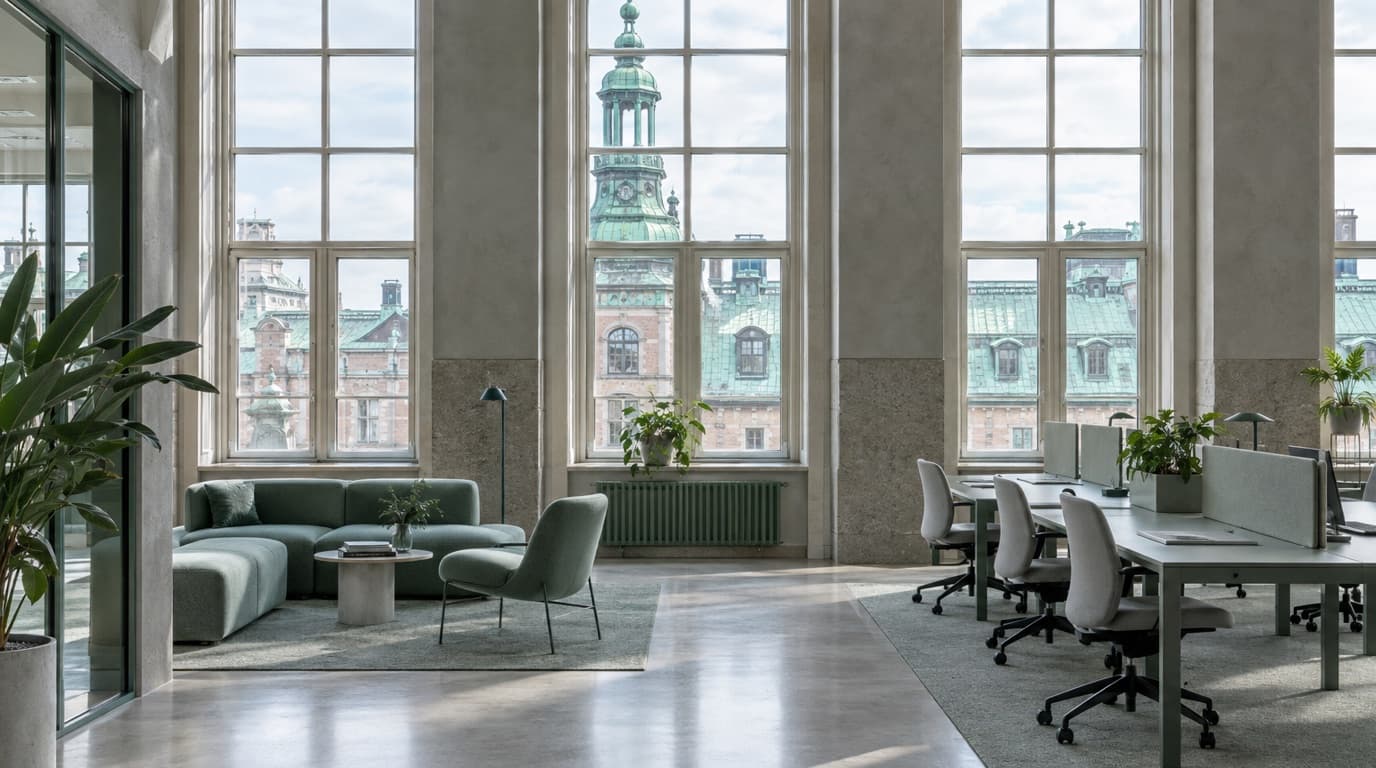
The future office is smaller, better and built for what people cannot do from home: collaboration, learning and community, but also concentrated work in peace and quiet. This is no longer a prediction. The latest surveys from Castellum, ISS and CBRE point the same way: most office workers are on site for most of the week, but they expect more from the office. Here we go through what the future workplace actually means and how to plan for it.
What is the future office? The short answer
The future office is a workplace that competes for people's presence instead of taking it for granted. In practice that means five things:
- Hybrid as the baseline: most people work in the office most days, but flexibility remains and matters for recruitment.
- More types of space: fewer identical desks, more focus rooms, phone booths, small meeting rooms and social areas.
- Higher demands on the building: location, services, air, light and energy performance weigh more than before.
- Technology as support: booking, sensors and AI are used to understand how the space is used.
- Flexible leases: the ability to grow or shrink without changing address.
The future office and ways of working: hybrid is the norm
The "everyone will work from home" debate has settled. In Castellum's annual survey Framtidens arbetsliv 2026 (The future of work 2026), conducted by Aura Insight among 3,999 office workers in Sweden, Denmark and Finland, 56 percent work in the office four to five days a week and one in three is always there. At the same time, when employees choose for themselves, they would like to be in the office slightly fewer days than they are today. Flexibility is still decisive for attracting staff, especially younger people: 86 percent of those under 25 say the option to work remotely is important.
The gap between leadership and employees also shows in ISS's report Kontorslivet 2026 (Office life 2026, May 2026, 1,444 participants): 36 percent of CEOs want to increase office attendance while 40 percent of employees want to work more remotely. 37 percent of larger companies in Sweden now allow less remote work than before.
The conclusion for the future office and ways of working is that attendance cannot be mandated in the long run. The office has to be worth the commute. More on how hybrid work affects space needs in our article on hybrid work and office space.
The office as a meeting place, but also for focus
It is easy to assume the future workplace is only about collaboration areas and lounges. The surveys say otherwise. When office workers in Castellum's report are asked what is missing, the answer is clear: quiet zones are the most requested space, followed by lounge areas and small meeting rooms. Demand for phone booths and focus rooms is highest among those in open-plan or activity-based offices.
The report also shows that 52 percent would prefer their own or a shared room, while only 15 percent prefer a fully activity-based office with no assigned desk. That does not make activity-based offices wrong, but they need enough space for concentration to work.
A good rule of thumb is to start from what your teams actually do in a normal week:
- How much time goes to meetings, and how many people attend them?
- How much is video calls that need a private space?
- Which tasks require long, uninterrupted concentration?
- Which days is the office full, and which is it half empty?
The answers decide the balance between desks, rooms and shared areas. How to calculate the size is covered in our guide to optimising office space for hybrid work.
The future workplace requires better buildings
Expectations of the building itself are rising. In CBRE's European Office Occupier Sentiment Survey 2026 (September 2026), 88 percent of companies say they would reject a building lacking essential amenities, up from 82 percent the year before. The main reasons to be in the office are engaging with colleagues (85 percent), a productive work environment (81 percent) and access to leadership (77 percent).
This also shows in the leasing market. Modern offices in central locations get let, while older space in weaker locations stays empty for longer. We describe that in more detail in our overview of the Swedish office market.
Sustainability is part of the same picture. The EU's recast Energy Performance of Buildings Directive (Directive (EU) 2024/1275) requires member states to renovate their worst-performing non-residential buildings: at least 16 percent of the stock by 2030 and 26 percent by 2033. For tenants, energy performance and environmental certification are becoming a standard question in an office search.
Technology and AI in the future office
Technology in the future office is less about gadgets and more about understanding how space is used. Occupancy, air quality and temperature sensors, digital booking systems for rooms and desks, and better video meeting equipment are already standard in many newer buildings.
AI is also expected to affect how much and what kind of space companies need. In CBRE's 2026 survey, 61 percent of companies expect AI to reshape their space requirements within two years. Exactly how is uncertain, but it argues for keeping leases and layouts as flexible as possible.
Flexibility in the space and in the lease
When needs change faster than a traditional three to five year lease, flexibility becomes part of the workplace strategy. Many companies combine a main office with flexible solutions for projects, growth or other cities. In CBRE's 2025 survey, European companies expected flexible space to make up about a third of their office portfolios within two years.
Flexibility can also be built into a standard commercial lease, for example through an option on additional space, the right to sublet part of the premises, or a shorter term in exchange for somewhat higher rent. We compare the formats in flexible vs traditional offices.
How to plan for the future office
- Measure how you work today. Look at attendance by weekday, meeting patterns and which spaces are full or empty.
- Decide what the office is for. Collaboration, client meetings, onboarding, focus? The priorities drive the layout.
- Size for a normal peak day, not for the absolute peak and not for the average.
- Set requirements for the building: proximity to public transport, services, indoor climate and energy performance.
- Negotiate flexibility into the lease so the space can follow your organisation as it changes.
Frequently asked questions
What does the future office look like?
The future office has fewer assigned desks and more types of space: quiet rooms, phone booths, small meeting rooms and social areas. It is often centrally located, in a building with good services and strong energy performance, with a lease that lets the space change over time.
Will offices disappear?
No. According to Castellum's 2026 survey, 56 percent of office workers are on site four to five days a week. What is changing is which offices are in demand: modern, well-located space gets let, while older space struggles to find tenants.
What is the difference between the future office and the future workplace?
The future workplace is a broader idea that covers the office, the home and other places where work happens. The future office is the physical space in that system, and its role is to offer what is hard to get anywhere else.
Does an activity-based office suit everyone?
Not always. In Castellum's report only 15 percent prefer a fully activity-based office, and those who work that way ask most for focus rooms and phone booths. Activity-based offices work best when there is plenty of space for concentration and clear rules for how it is used.
Thinking about what your next office should look like? Tell us what you need and we will match you with the right office within 24 hours.