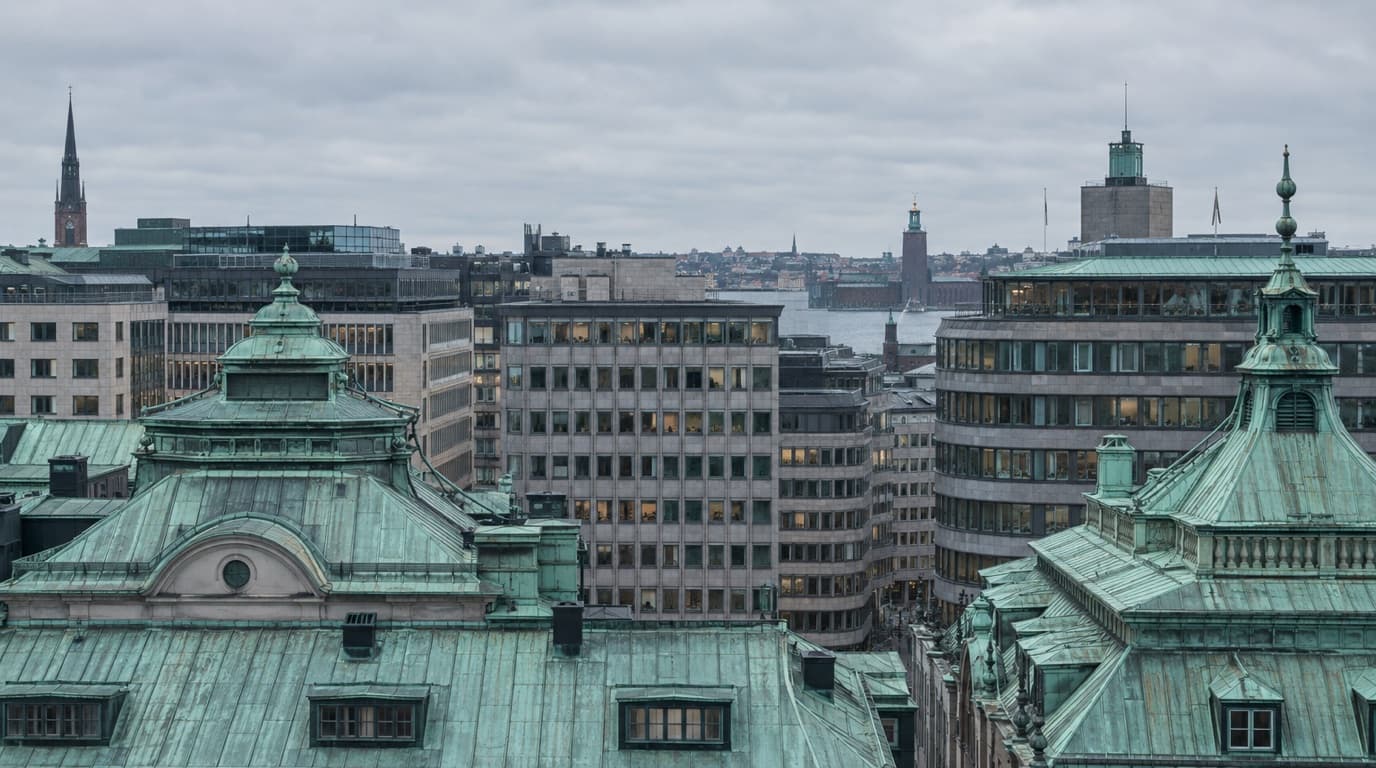
The Swedish office market is split in two. In Stockholm's CBD vacancy is low and prime rents are rising, while decentralised areas and older stock have high vacancy. At the same time the investment market has woken up: volume in the first half of 2026 was the highest in several years. Here we summarise the situation using figures from the latest published reports, and what it means for you whether you rent or own offices.
The Swedish office market in numbers
The table is based on Cushman & Wakefield's Sweden office MarketBeat for Q2 2026, published in July 2026.
| Metropolitan region | Office stock | Overall vacancy | CBD vacancy | Prime CBD rent | Prime yield |
|---|---|---|---|---|---|
| Greater Stockholm | 12.5 million sq m | 18.5% | 8.0% | SEK 9,850/sq m/year | 3.75% |
| Greater Gothenburg | 5.6 million sq m | 15.0% | 17.0% | SEK 4,500/sq m/year | 4.50% |
| Greater Malmö | 2.7 million sq m | 17.0% | 9.0% | SEK 3,800/sq m/year | 4.80% |
Two things are worth knowing when reading these numbers. First, prime rent is an assessment of what the best premises in the best locations can be let for, not an average rent. Second, research houses define areas and vacancy differently. Newsec, JLL, CBRE and Cushman & Wakefield may therefore report different vacancy rates for the same city and period. The trend within one source is the most useful signal.
The Stockholm office market
Stockholm is Sweden's largest office market and the one where differences between locations are clearest. According to Cushman & Wakefield's Stockholm MarketBeat for Q2 2026, vacancy has held at 18.5 percent since Q4 2025, after a wave of completions had earlier outpaced demand. By submarket:
| Submarket | Vacancy | Prime rent |
|---|---|---|
| CBD | 8.0% | SEK 9,850/sq m/year |
| Rest of the inner city | 14.0% | SEK 6,200/sq m/year |
| Decentralised areas | 23.0% | SEK 4,100/sq m/year |
Prime rent in the CBD rose during the quarter and was about 0.5 percent higher than a year earlier. In decentralised areas it rose by about 2.5 percent year on year, while it was unchanged in the rest of the inner city.
At the very top of the market things move faster still. According to JLL's Nordic Outlook for autumn 2026, 17 percent of lettings in Stockholm's CBD in 2025 were signed above the published prime rent, compared with 9 percent in 2023.
Supply of brand-new offices is limited. In the first half of 2026, 45,800 sq m of offices were completed in Greater Stockholm, with about 44,000 sq m more expected in the second half. Around 180,000 sq m was under construction at mid-year. The quarter's largest lettings were Ericsson's leases of 58,000 sq m with Atrium Ljungberg and 39,700 sq m with Castellum, both in Hagastaden.
To see what it costs to rent in different parts of the city, read office prices in Stockholm and our district guide to attractive office areas in Stockholm.
Gothenburg and Malmö
In Gothenburg overall vacancy was 15.0 percent and unchanged in Q2 2026, according to Cushman & Wakefield. Prime CBD rent stayed at SEK 4,500 per sq m per year. Gothenburg has substantial new supply on the way: 31,000 sq m was completed in the first half and about 79,000 sq m was under construction.
In Malmö vacancy rose by one percentage point to 17.0 percent, and CBD vacancy increased to 9.0 percent. Prime CBD rent was unchanged at SEK 3,800 per sq m per year. The construction pipeline is small, about 12,000 sq m.
Transactions and investment
The investment market has picked up. According to Cushman & Wakefield (reported in August 2026), transaction volume in Sweden reached SEK 120.5 billion in the first half of 2026, up 60 percent on the same period a year earlier and the strongest half-year growth since 2021. Offices accounted for 13 percent of volume, SEK 15.8 billion. Residential (25 percent) and warehouse, logistics and industrial (22 percent) were larger segments. Cushman & Wakefield expects the full year 2026 to exceed SEK 200 billion.
JLL's picture is similar: about SEK 122 billion across just over 160 transactions. Swedish buyers accounted for 91 percent of volume, and JLL describes the increase as driven mainly by owners rebalancing their portfolios rather than a broad wave of new buyers. Listed Nordic property companies traded at a median discount to net asset value of 41 percent at the end of August 2026, up from 34 percent in the spring.
Yields and values
Yields for the best offices have come down slightly. In Q2 2026 Cushman & Wakefield put the prime yield in Stockholm's CBD at 3.75 percent, 15 basis points lower than a year earlier. In Gothenburg and Malmö it fell by 5 basis points to 4.50 and 4.80 percent respectively. Lower yields mean higher values for the best properties, but say little about older offices in weaker locations, where few deals are done.
Office market outlook: what happens next?
Nobody can forecast the market precisely, but the reports point in some clear directions:
- The split persists. Modern offices in central locations keep vacancy low, while older stock in outer locations needs refurbishment, conversion or lower rents to get let.
- Less new construction. Fewer new offices are being completed, which over time may push down vacancy in the best segments and support rents there.
- More investment activity. Both Cushman & Wakefield and JLL expect the highest transaction volume in several years, even if offices are a smaller share than before.
- Demand is driven by quality. Office attendance has stabilised, and companies choose fewer but better square metres. We describe this in more detail in 10 office real estate trends.
What does the office market mean for you?
As a tenant you have a strong negotiating position outside the CBD and in older buildings, where landlords can often offer rent-free months, fit-outs or flexible terms. In the CBD it is the opposite: the best premises go quickly and often above reported levels, so it pays to start early.
As a landlord with older space, the question is not whether but how to meet expectations on quality, amenities and energy performance. We cover how to work with empty space in reducing vacancy.
Frequently asked questions
What does the Swedish office market look like in 2026?
The office market is split in two. According to Cushman & Wakefield, vacancy was 8.0 percent in Stockholm's CBD but 18.5 percent across Greater Stockholm in Q2 2026. Transaction volume rose sharply in the first half, and offices made up 13 percent of it.
How high is office vacancy in Stockholm?
Cushman & Wakefield reports 18.5 percent for Greater Stockholm, 8.0 percent in the CBD, 14.0 percent in the rest of the inner city and 23.0 percent in decentralised areas (Q2 2026). Other research houses may report other levels because they define areas differently.
What is prime office rent in Stockholm?
According to Cushman & Wakefield, prime rent in Stockholm's CBD was SEK 9,850 per sq m per year in Q2 2026. Prime rent refers to the best premises in the best locations. According to JLL, 17 percent of CBD lettings in 2025 were signed above the published prime rent.
Will office rents fall?
It depends on the segment. In decentralised areas and older stock with high vacancy, landlords commonly offer discounts and other incentives. In Stockholm's CBD prime rents rose in 2026, and the limited supply of new offices does not point to falling rents there.
Looking for an office and want to know what is available right now? Tell us what you need and we will match you with the right office within 24 hours.