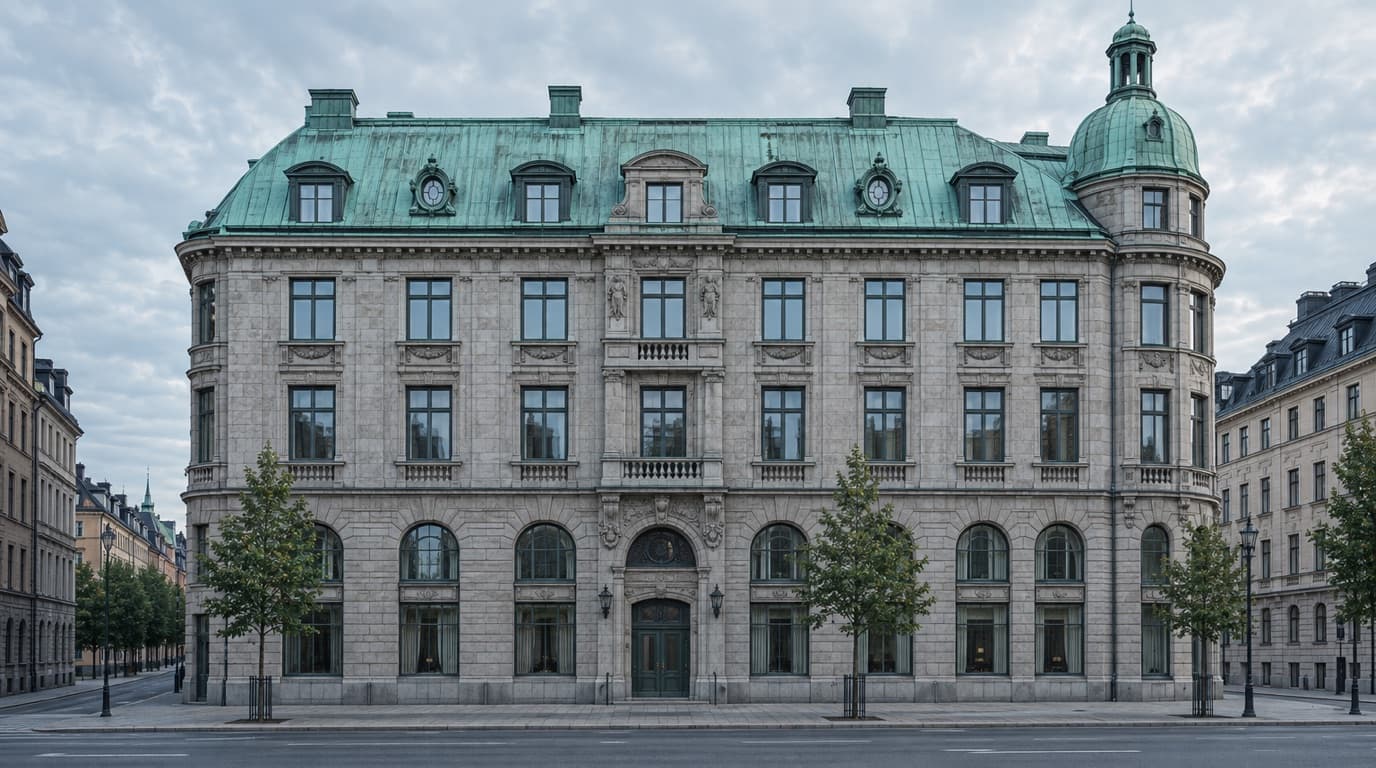
What does it cost to rent an office in Stockholm in 2026? According to the latest broker reports, prime rents in central Stockholm (the CBD) are around SEK 9,800 per square metre per year, around SEK 6,200 in the rest of the inner city and around SEK 4,100 in outer areas such as Solna, Sundbyberg and Kista. Those are levels for the best space in each submarket. Most leases are signed below them. Here we explain what the figures mean, what is included in the rent and how to work out what an office costs per month and per person.
Office rent in Stockholm: prices by area in 2026
Commercial rents in Stockholm differ by more than a factor of two between the city centre and the outer areas. The two most recent public reports on the Stockholm office market are Cushman & Wakefield's MarketBeat for the second quarter of 2026 and JLL's quarterly analysis for the same period.
| Submarket | Prime rent (SEK/sqm/year) | Vacancy | Source |
|---|---|---|---|
| CBD (central Norrmalm and Östermalm) | 9,850 | 8.0% | Cushman & Wakefield, Q2 2026 |
| City Centre (rest of the inner city) | 6,200 | 14.0% | Cushman & Wakefield, Q2 2026 |
| Decentralised (outer areas) | 4,100 | 23.0% | Cushman & Wakefield, Q2 2026 |
| Hagastaden | 5,800 | JLL, Q2 2026 | |
| Stockholm overall | 18.5% | Cushman & Wakefield, Q2 2026 |
Sources: Cushman & Wakefield, MarketBeat Stockholm Office Q2 2026 (prime rents are weighted net asking rents) and JLL, Stockholm Office Market Dynamics Q2 2026.
JLL puts prime CBD rent at SEK 9,800/sqm/year, up 3.2 percent year on year. JLL's Nordic office report from February 2026 shows that top CBD deals reached SEK 12,000/sqm/year while the median new CBD lease was SEK 8,200/sqm/year. That says more about what an ordinary tenant pays in the city centre than the prime rent does.
How the districts differ in character and price level is covered in our guide to office districts in Stockholm.
What does prime rent mean?
Prime rent is what the best space in the best location in a submarket can command: new or newly refurbished space with a high specification and efficient layouts. Older space, poor layouts, locations further from the metro and smaller units without fit-out are often let well below prime.
Three things decide where in the range a given space ends up:
- Location within the area: Proximity to T-Centralen, Stureplan or a commuter rail station pushes rent up.
- Specification and age: New offices with environmental certification command higher rents than older stock.
- Size and lease length: Larger spaces and longer leases give room to negotiate, both on rent and on tenant fit-out.
Vacancy matters too. With overall vacancy at 18.5 percent according to Cushman & Wakefield, and up to 36 percent in Kista according to JLL, tenants in many submarkets have a stronger negotiating position than a few years ago. In the CBD vacancy is lower and rents have kept rising.
What is included in the rent? Cold rent, warm rent and supplements
When you compare spaces you need to know exactly what the rent covers. This is the most common source of misleading comparisons.
- Cold rent (kallhyra): Rent excluding heating, cooling and electricity, which are paid as supplements or through your own contracts. With cold rent your cost follows consumption and energy prices, so ask for last year's actual costs before comparing with a space let on warm rent.
- Warm rent (varmhyra): Rent including heating, sometimes also cooling and building electricity.
- Property tax: For commercial premises it is 1 percent of the assessed value (Swedish Tax Agency). Landlords often charge it as a separate supplement in proportion to your area.
- Operating costs: Cleaning, waste, snow clearance, common areas and sometimes building services may be included or charged separately.
- VAT: If the landlord has opted for voluntary taxation, 25 percent VAT is added to the rent. For VAT-registered companies it is normally deductible, but it affects cash flow.
- Indexation: Most leases of three years or longer are indexed annually to CPI.
How VAT, index clauses and supplements are handled in the lease is covered in our checklist for renting an office.
Worked example: what does an office cost per month?
A worked example makes the figures concrete. Take a company with 20 employees that needs about 300 sqm.
| Inner city (SEK 6,200/sqm/year) | Outer area (SEK 4,100/sqm/year) | |
|---|---|---|
| Annual rent, 300 sqm | SEK 1,860,000 | SEK 1,230,000 |
| Per month | SEK 155,000 | SEK 102,500 |
| Per employee per month | SEK 7,750 | SEK 5,125 |
The example uses the prime rents in Cushman & Wakefield's report and excludes supplements, property tax and VAT. Your actual rent may be lower or higher. Square metres per person vary a lot: with hybrid work and shared desks you often need less space. Read more in our guide to office space per employee.
Serviced offices and desks: what do they cost?
In a serviced office or coworking space you usually pay per desk or per room per month, not per square metre. The price normally includes furniture, internet, cleaning, electricity, reception, kitchen and access to meeting rooms and shared areas. Terms are short, often from one month.
The price per square metre is therefore higher than for a lease of your own, but the total cost can be lower for small teams because you avoid furniture, fit-out and your own running costs. Prices vary widely with location and service level, so always compare the total price per person with what your own office would cost including all supplements. We compare the options in our article on flexible offices and serviced offices.
Where are office rents heading?
The reports point the same way: demand is concentrating on central locations and modern, well-located buildings, while older space in outer areas is finding it harder. Cushman & Wakefield notes that vacancy has held at 18.5 percent since the fourth quarter of 2025 and sees signs of stabilisation. According to the same report, 45,800 sqm of offices were completed in Greater Stockholm in the first half of 2026, with about 44,000 sqm more expected in the second half.
For you as a tenant this often means room to negotiate outside the CBD, on rent, rent-free months and fit-out.
Frequently asked questions
How much does it cost to rent an office in Stockholm per square metre?
According to Cushman & Wakefield (Q2 2026), prime rents are around SEK 9,850/sqm/year in the CBD, SEK 6,200 in the rest of the inner city and SEK 4,100 in outer areas. JLL reports a median new CBD lease of SEK 8,200/sqm/year. Older space is often let below these levels.
How high are commercial rents in Stockholm?
For offices, most new leases are signed below prime rent: JLL puts the median CBD lease at SEK 8,200/sqm/year, against a prime rent of around SEK 9,850. In the rest of the inner city prime rent is around SEK 6,200/sqm/year and in the outer areas around SEK 4,100. Rents for retail and warehouse space follow other markets and are not included in these figures.
How much does an office cost per month?
Divide the annual rent per square metre by twelve and multiply by the area. A 100 sqm office at SEK 6,000/sqm/year costs SEK 50,000 a month, before supplements, property tax and VAT.
Is there VAT on office rent in Sweden?
Commercial rent is VAT-exempt as a main rule, but the landlord can opt for voluntary taxation, in which case 25 percent VAT is added. If you are VAT-registered you can normally deduct it.
What is the difference between cold rent and warm rent?
Cold rent excludes heating and often electricity and cooling, which are then paid separately. Warm rent includes heating. Always check which applies before comparing two spaces.
Is it cheaper to rent an office outside the inner city?
Yes, rents in outer areas such as Solna, Sundbyberg and Kista are generally well below the inner city. Vacancy is also higher there, which gives you more negotiating power.
Get a shortlist that fits your budget
Shace searches the whole Stockholm office market and sends a handpicked shortlist within 24 hours, based on your budget and needs. Tell us what you need and we will match you with the right office.