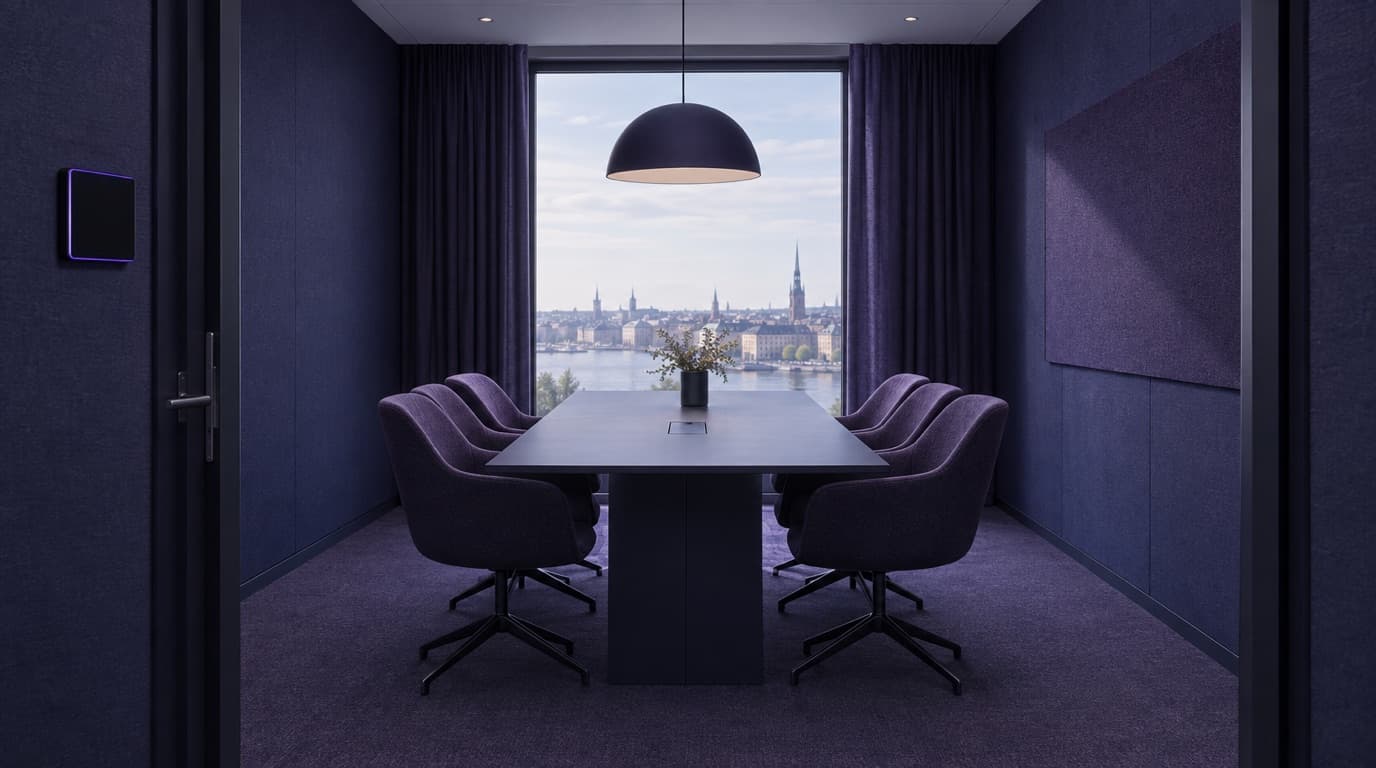
Smart offices use connected technology to make the premises more comfortable, easier to use and cheaper to run: sensors that adjust ventilation to how many people are present, room and desk booking, digital access control and energy management. Some of the technology sits in the building and is run by the landlord, some you choose yourselves. Here we cover what actually helps, what is the building's responsibility and what to ask for when you are looking for premises.
What is a smart office?
Short answer: an office where systems for climate, lighting, access and booking are connected and can respond to how the space is actually used. It helps to separate two levels:
| Smart building | Smart office | |
|---|---|---|
| What it is | The building's own systems: ventilation, heating, cooling, lighting, lifts, access, energy metering | The tools you use in your premises: room booking, desk booking, meeting room technology, visitor systems |
| Who owns and runs it | Usually the landlord | Usually you as the tenant |
| What you can influence | Through choice of premises and the lease | Through your own purchases and routines |
A smart building provides the foundation. A smart office is what you build on top. You get the best result when the two work together, for example when the booking system knows which rooms are free and the building turns down ventilation in rooms nobody is using.
Sensors and indoor climate
Sensors are the basis of most smart buildings. The most common ones measure:
- Carbon dioxide (CO₂), which shows whether ventilation is sufficient for the number of people in the room. High levels cause tiredness and poorer concentration.
- Temperature and humidity, so heating and cooling can be controlled per zone.
- Presence, so lighting and ventilation can be reduced in empty rooms and booked but unused meeting rooms can be released.
Demand-controlled ventilation, which increases as a room fills and decreases as it empties, is one of the clearest examples of technology delivering both better air and lower energy use. Air quality and ventilation are also a work environment requirement, as we describe in our article on office ergonomics and the work environment.
Room and desk booking
Digital booking systems are standard in many offices today, especially with hybrid work. They do three things:
- Reduce clashes over meeting rooms and make it easy to find a free room.
- Make shared desks workable without people hunting for a seat in the morning.
- Provide usage data. How many people are in and how often meeting rooms are actually used is the best basis you have for deciding how big an office you need.
Link booking to presence sensors if you can, so rooms that are booked but unused are released automatically. That is often where the biggest gain is.
Access control and security
Digital access systems replace keys with phones or cards that can be blocked and given permissions centrally. The benefits are clear: you can give a new employee or consultant access the same day, block a lost key at once and control who gets in when.
Ask the landlord how access to the building, lifts and garage works, and whether your own system for the premises can be linked to the building's. Two different cards for the main entrance and the office door is a common annoyance.
Remember that access data and cameras involve personal data. Processing must comply with the GDPR, and camera surveillance has its own rules. Tell employees what is recorded and why.
Energy management and follow-up
Smart buildings control lighting, heating, cooling and ventilation by schedule and presence and track energy use continuously. As a tenant, two things are worth asking about:
- Separate metering of your premises. Then you can see and follow up your actual energy use, which helps with your own sustainability reporting.
- Operating hours. How are ventilation and heating run in the evenings and at weekends, and can they be extended when you need it?
Energy management is part of what environmental certifications assess. Read more about what Miljöbyggnad and BREEAM mean for you as a tenant.
Connectivity: what has to work first
The most basic technology is often forgotten at the viewing:
- Fibre to the building and a choice of operator.
- Indoor mobile coverage. Modern energy-efficient windows can weaken mobile signals. Test it yourselves in the space.
- Wifi that can handle many simultaneous video calls throughout the premises.
- Power outlets and cable routes where you want desks and meeting rooms.
No sensor makes an office smart if the video call keeps breaking up.
Privacy: measure the space, not the people
Sensors and booking data can give a good picture of how the space is used, but they should be used to improve the premises, not to monitor individual employees. Some rules of thumb:
- Choose solutions that measure occupancy at room or zone level, not individuals.
- Be open about what is measured and why.
- Only collect what you actually use.
If you are considering AI-based tools in the office, the EU AI Act also applies. We cover it in our article on AI in the office.
Questions to ask the landlord
- Is there demand-controlled ventilation, and can the climate be controlled per zone?
- How does building access work, and can our system connect to the building's?
- Can we get separate metering of electricity and energy for our premises?
- What is indoor mobile coverage like, and which fibre operators are available?
- Which sensors are already in the building, who owns the data and can we access it for our premises?
- What operating hours apply to ventilation and heating?
Avoid technology you do not need
It is easy to buy more technology than you use. Start with the needs: do the meeting rooms work, are there free desks when people come in, is the air good in the afternoon? Solve those problems first. A simple booking tool and a well-ventilated building do more good than an app with twenty features nobody opens.
Frequently asked questions
What is a smart building?
A building where technical systems such as ventilation, heating, lighting and access are connected and controlled according to how the building is used, often with the help of sensors. The goal is a better indoor environment, lower energy use and simpler operation.
What does it cost to make an office smart?
It depends on what the building already has. The building's systems are normally paid for by the landlord and included in the rent, while booking systems, meeting room technology and your own sensors are something you pay for yourselves, often as a monthly cost per user or room.
Can an employer use sensors in the office?
Yes, but if the sensors can be linked to individuals it is processing of personal data and the GDPR applies. The simplest approach is to choose sensors that measure occupancy per room or zone and to tell employees what is measured.
Which technology matters most in an office?
Stable connectivity, working meeting room technology and good ventilation. After that, room booking linked to presence sensors often gives the most value for money.
Looking for premises with the right technology from day one? Tell us what you need and we will match you with the right office within 24 hours.