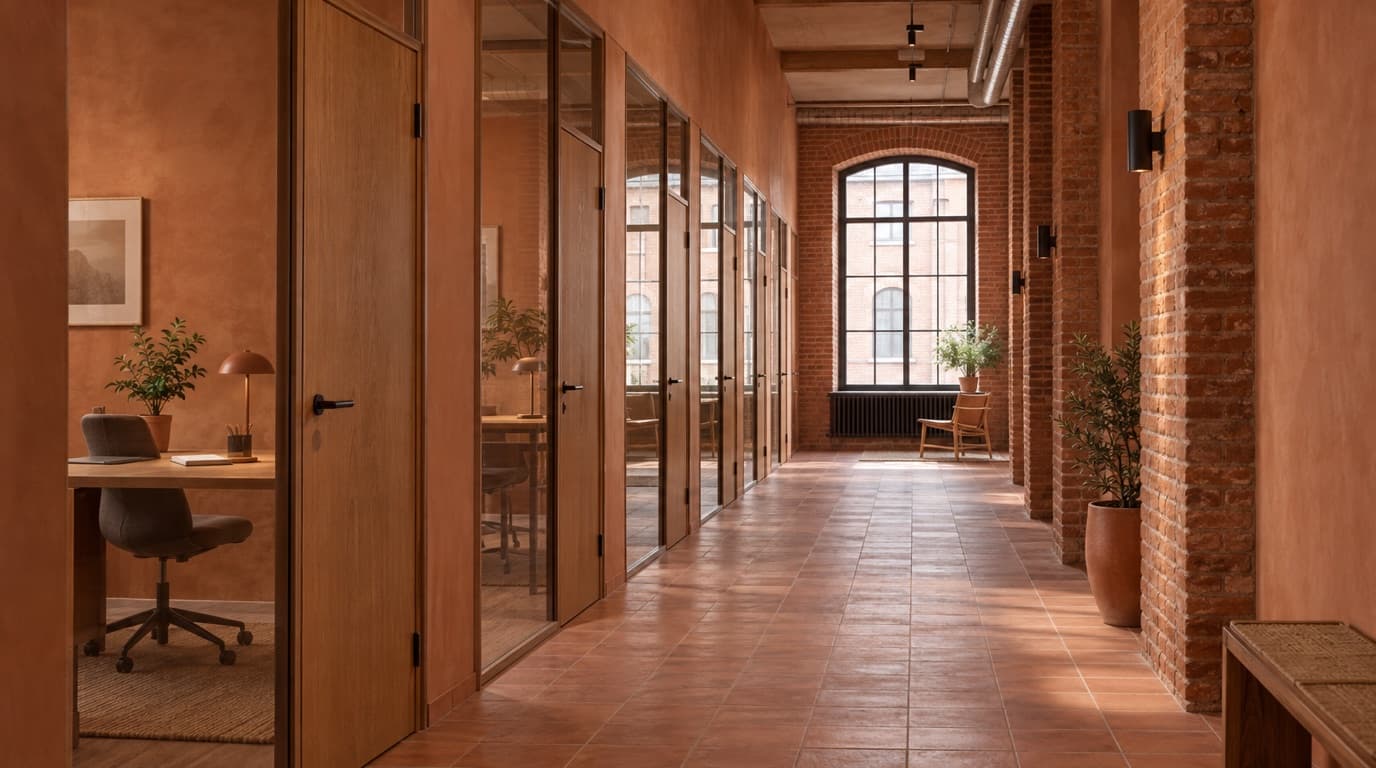
A kontorshotell (literally "office hotel", the Swedish term for a serviced office) is a ready-made office you move into without arranging furniture, internet, cleaning or reception yourselves. You rent a room or a few desks, pay one monthly price and commit for a shorter time than under an ordinary lease. Here we explain what a kontorshotell is, what can be included, how the price works, which contract terms apply in Sweden and when an office of your own becomes the better choice.
Short answer: A kontorshotell is a furnished office run by an operator, where several companies rent their own rooms and share reception, kitchen and meeting rooms. The price is quoted per room or desk per month, with furniture and running costs included. Agreements are shorter than an ordinary commercial lease and the notice period is set by the agreement, which suits small and growing teams that want to get started quickly. An office of your own on a commercial lease can be cheaper per desk once the team is larger and you know roughly how large the team will be over the next few years.
What is a kontorshotell?
A kontorshotell is office premises that an operator leases or owns, has fitted out and runs day to day. You rent part of it, for example a lockable room of your own, and share the rest with the other companies in the building. In English it is called a serviced office or business centre, and Swedish listings also use the words flexkontor and flexibelt kontor (flexible office).
The difference from an ordinary office lies in the arrangement. You get a working office instead of renting empty space and fitting it out yourselves.
What is included in a kontorshotell?
A kontorshotell is sold as a ready-made office, but exactly what the monthly price includes is up to the operator. Go through these points:
- A furnished room or desks. Desks, chairs and storage are in place.
- Internet and electricity. The network is set up and running costs are covered.
- Cleaning. Of both your room and the shared areas.
- Reception. Someone who receives visitors and post. Ask when it is staffed.
- Kitchen and lounge. Ask whether coffee is included.
- Meeting rooms. Free to use, with a number of hours a month, or charged by the hour.
Ask as well what costs extra, for example parking, printing, telephone answering, storage, signage and meeting rooms beyond what is included, and whether you have access around the clock or only during office hours.
What is the difference between a kontorshotell and coworking?
In a kontorshotell you rent a room of your own with a door. In a coworking space you rent a desk in an open, shared office, either a fixed desk that is yours or a flexible one where you take whichever is free. The line is blurred, since an operator can offer both private rooms and desks in open-plan areas in the same building.
The choice mostly comes down to how much privacy you need. If you take many calls, handle sensitive material or want to leave things out on the desk, a room of your own is a better fit. If you are one or two people who mainly need somewhere to sit, coworking may be enough. There is more on renting single desks in our guide to renting a desk or sharing an office. If you only need an address and not a workplace, a virtual office is a third option.
Kontorshotell or your own office: a comparison
| Kontorshotell | Coworking | Own office on a lease | |
|---|---|---|---|
| What you rent | Your own furnished room, shared common areas | A desk in an open shared office | Premises of your own |
| Price | Per room or desk per month | Per desk per month | Per square metre per year, plus running costs and supplements |
| Agreement | Agreement with the operator, shorter than an ordinary lease | Agreement with the operator for a desk | Commercial lease with the landlord |
| Notice | As agreed | As agreed | Normally nine months for leases longer than nine months |
| Moving in | Furnished and ready to move into | Furnished and ready to move into | After searching, negotiating and fitting out |
| Furniture and day-to-day management | Included | Included | You arrange it yourselves |
| Scope to make it your own | Limited | Very limited | Wide, within the terms of the lease |
Terms differ between operators and landlords, so always read the agreement.
What does a kontorshotell cost?
The price is quoted per room or per desk per month. Ask whether it is stated with or without VAT. The price is driven by the same things as the rent for a whole office, namely location, standard and service, and also by the size of the room. We give no price levels here, because they vary too much between cities, buildings and operators for an average to mean anything. Ask a couple of operators for a quote and compare what is included.
A per-square-metre comparison with premises of your own is a poor one, because the price of a kontorshotell includes things you otherwise pay for on top of the rent: furniture, internet, cleaning, electricity, reception and shared areas. We explain what sits outside the rent in an ordinary Swedish commercial lease in our guide to kallhyra and varmhyra.
So work out the total cost per desk per month, for the time you expect to stay:
- Kontorshotell: the monthly price plus extras such as meeting rooms and parking.
- Own office: rent and supplements, running costs, and furniture and fit-out spread over the lease term.
Then divide the total by the desks you actually use, so the cost of desks that stand empty shows too. You lease premises of your own for the size you expect to reach, while in a kontorshotell you pay for the room or desks you rent today.
Which contract terms apply to a kontorshotell?
The agreements are shorter than an ordinary commercial lease, and the notice period is set by the agreement. There is no standard, so read what your own agreement says about the term, notice, price increases and the deposit.
For an ordinary commercial lease, the law sets rules that affect how quickly you can leave the premises. Under Chapter 12 of the Swedish Land Code (jordabalken), the notice period is normally nine months for premises let for an indefinite term or for a fixed term longer than nine months (section 4). Once the tenancy has lasted more than nine consecutive months, the tenant also normally has indirect security of tenure, meaning a right to compensation if the landlord refuses to renew without an acceptable reason (sections 56 and 57). We describe how that protection works in our guide to security of tenure for commercial premises.
Ask the operator which type of agreement you are signing and what happens if either of you wants to end it. A short agreement makes it easier to grow, shrink or move without being tied in for several years. There are more ways to rent an office without a long commitment in our guide to offices on short leases.
Who does a kontorshotell suit?
- Small teams. You want a private office without having to manage premises yourselves.
- Companies that are growing or unsure of their size. Ask whether you can move to a larger or smaller room in the same building.
- Companies setting up in a new city. You move into a ready-made office and avoid a long commitment before you know how it goes.
- Project teams. A team with a known end date does not need an agreement that outlasts the project.
- Companies waiting for premises of their own. A kontorshotell works as a stopgap during a refurbishment or a move.
When is your own office better?
An office of your own can be the better choice when the team is larger, its size is predictable and you expect to stay for several years. The cost per desk can then be lower, and you have more say over the layout, meeting rooms, acoustics and signage. The same applies if you have particular requirements, for example for security, lab space or room for clients.
There is no fixed threshold for when it pays to switch. A good moment to run the numbers is when you rent several rooms in the same kontorshotell or start struggling for space. The two can also be combined, with a head office of your own and rooms in a kontorshotell in other cities. There is a broader comparison in our guide to flexible and traditional offices.
What to ask before choosing a kontorshotell
- What is included in the monthly price, and what costs extra?
- How many meeting room hours are included, and how are they booked?
- How long is the notice period, and is there a minimum term?
- How and when can the price be raised?
- Is a deposit required?
- Do we have access around the clock?
- Can we switch to a larger or smaller room during the agreement?
- Can we register the company's address here and put up a sign?
Frequently asked questions
What is a kontorshotell?
A furnished office run by an operator, where several companies rent their own rooms and share reception, kitchen and meeting rooms. Furniture, internet, cleaning and running costs are included in a monthly price.
What does a kontorshotell cost?
The price is quoted per room or desk per month and depends on location, standard and service. Levels vary a great deal between cities and buildings. Compare the total cost per desk, including extras such as meeting rooms and parking, with the total cost of an office of your own, including running costs and fit-out.
What is the difference between a kontorshotell and coworking?
In a kontorshotell you have a lockable room of your own. In a coworking space you sit at a fixed or flexible desk in an open shared office. Some operators offer both.
What notice period does a kontorshotell have?
The notice period is set out in the agreement, so ask the operator. An ordinary Swedish commercial lease for a term longer than nine months normally has a nine-month notice period under the Land Code.
Can a company have its registered address at a kontorshotell?
Ask the operator. An address alone without a workplace is known as a virtual office.
Find the right office faster
Shace searches the whole office market for you, from serviced offices and coworking to offices of your own, and sends a handpicked shortlist within 24 hours. Tell us what you need and we will match you with the right office.
This article is general information, not legal, tax or financial advice. Shace is not responsible for decisions made on the basis of it. Speak to a lawyer or other adviser before acting in an individual case.