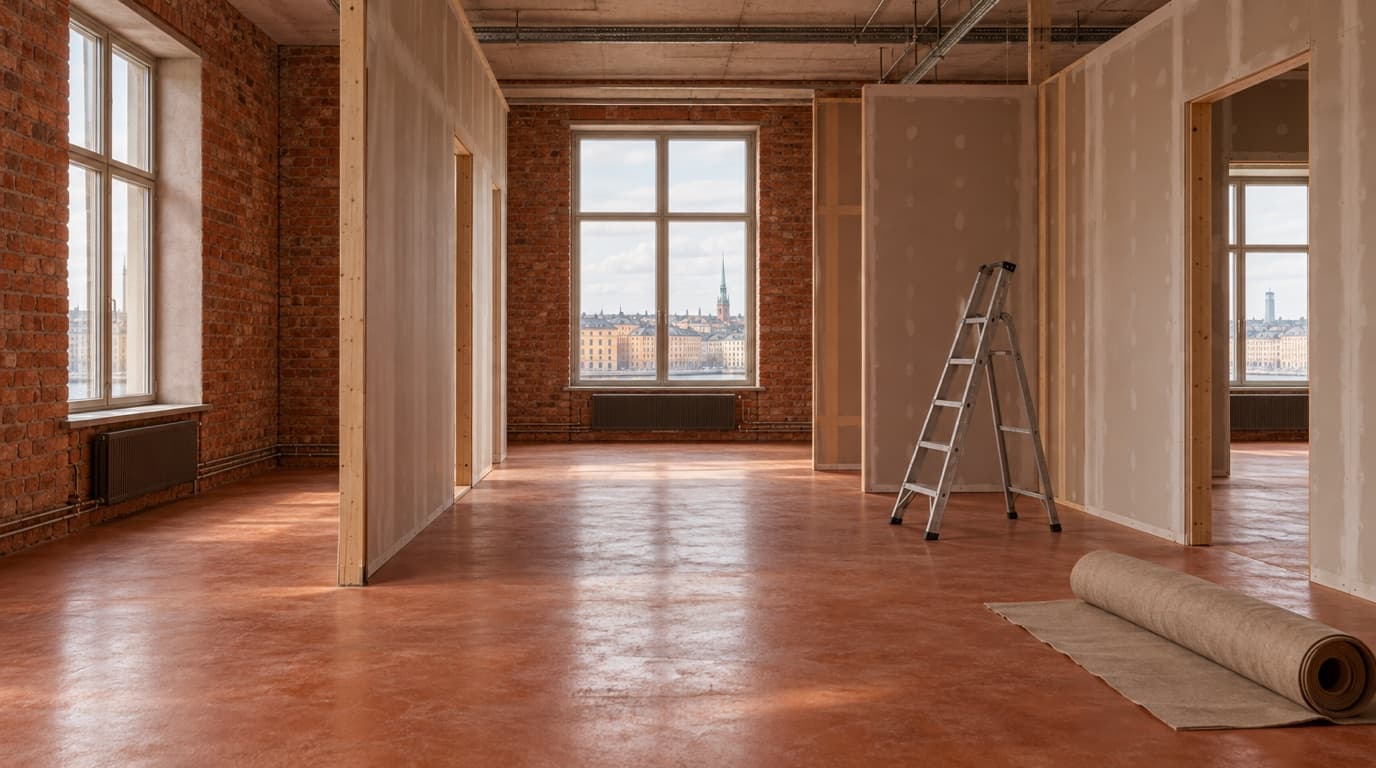
Few offices fit exactly as they are. Walls need to be moved, meeting rooms built and surfaces replaced before you can move in. That work is called tenant fit-out (hyresgästanpassning), and it is often the biggest single negotiating point after the rent. Here we go through what it covers, who pays and what should be in the lease. Most of it applies to any type of premises, but the examples are based on fitting out an office.
Short answer: Tenant fit-out is the conversion of premises carried out for a specific tenant. The cost is paid by the landlord, by the tenant or shared, often through a supplement on the rent over the lease term. Agree the scope, cost, timeline and reinstatement in writing before the lease is signed.
What is tenant fit-out?
Tenant fit-out covers every change to the premises made so they work for your particular business. It can be anything from repainting to a completely new layout. Common elements:
- Layout: new or removed walls, meeting rooms, phone booths, reception
- Surfaces: floors, walls, ceilings
- Installations: ventilation, cooling, electricity, lighting, data network
- Kitchenette, kitchen and wet rooms
- Acoustics, access control and signage
Furniture and furnishings are normally not included and are your own responsibility. We go through how the space should be designed in the guide to office design.
Who pays for the tenant fit-out?
There is no rule in law. Everything is negotiated, and three arrangements are common.
| Arrangement | How it works | Suits when |
|---|---|---|
| Landlord pays | The fit-out is included in the rent. The landlord recovers the investment over the lease term. | You sign a longer lease and the fit-out is standard |
| Rent supplement | The landlord builds, you pay a separate supplement over the lease term. | The fit-out is larger or more specific to you |
| Tenant pays | You pay directly, either to the landlord or to your own contractor. | The lease is short or the fit-out is highly specialised |
Three things decide how much the landlord is willing to cover:
- Lease term. A five-year lease gets more fit-out than a three-year lease.
- How generic the fit-out is. The landlord is happier to pay for what the next tenant can also use.
- Market conditions. When vacancy in the area is high, the willingness to invest to secure a tenant goes up.
Worked example
Fitting out 300 square metres costs SEK 450,000. Spread as a supplement over a five-year lease, that is SEK 90,000 a year, or SEK 300 per square metre per year, before interest. The figures are an example. Actual costs vary a lot depending on the condition of the premises and what needs doing.
What the lease should cover
- Scope. A written description with drawings of what will be built, and the standard of materials.
- Cost and payment. Fixed price or time and materials, and who covers cost overruns.
- Timeline and access. When the premises will be ready and what happens if they are late, for example rent-free time or reduced rent.
- Changes during the build. How changes and additions are ordered and priced.
- Maintenance. Who maintains and replaces what is built, ideally in a responsibility matrix (gränsdragningslista).
- Early exit. Whether you must pay the remaining supplement if you leave before the lease term ends.
- Reinstatement. Whether the premises must be restored when you move out, and if so to what condition.
Reinstatement is the point most often forgotten. If the lease says the premises must be restored to their original condition, it can be a large cost on the day you move out. Have it removed or clearly limited from the start.
Doing the work yourselves?
You may not convert the premises without the landlord's consent. Get the consent in writing. It also matters if the landlord later terminates the lease: for compensation under the rules on security of tenure (besittningsskydd) for commercial premises, losses linked to a conversion you paid for yourselves only count if the landlord consented to it, or if you entered into the lease on the understanding that you would be allowed to carry it out.
How long does it take?
Expect several months from decision to move-in. Design, procurement and construction take time, and longer if a building permit (bygglov) is needed. The fit-out often decides when you can move in, so start well before the last notice date on your current lease. The full timeline is in the checklist for renting an office.
For landlords
A clear picture of what you are prepared to fit out, and at what rent, shortens the time from viewing to signed lease. Show floor plan sketches of different layouts in the listing itself, and be clear about what is included in the rent. More advice is in the guide to letting commercial space.
Frequently asked questions
What does tenant fit-out mean?
Converting premises so they suit a specific tenant's business.
Who pays for tenant fit-out?
It is negotiated. The landlord, the tenant or both, often through a supplement on the rent over the lease term.
Do we have to reinstate the premises when we move out?
Only if the lease says so. Check the wording before you sign.
Who owns what is built?
Fixtures such as walls and installations that the landlord paid for belong to the property. What you paid for yourselves does not become part of the property under the Land Code as long as you own it, but in practice the lease decides what happens to it when you move out: often it must either be removed or left behind without compensation. Your furniture and movable equipment are yours.
Find the right office faster
Shace searches the whole office market for you, sends a handpicked shortlist within 24 hours and helps with viewings and the lease. Tell us what you need and we will match you with the right office.