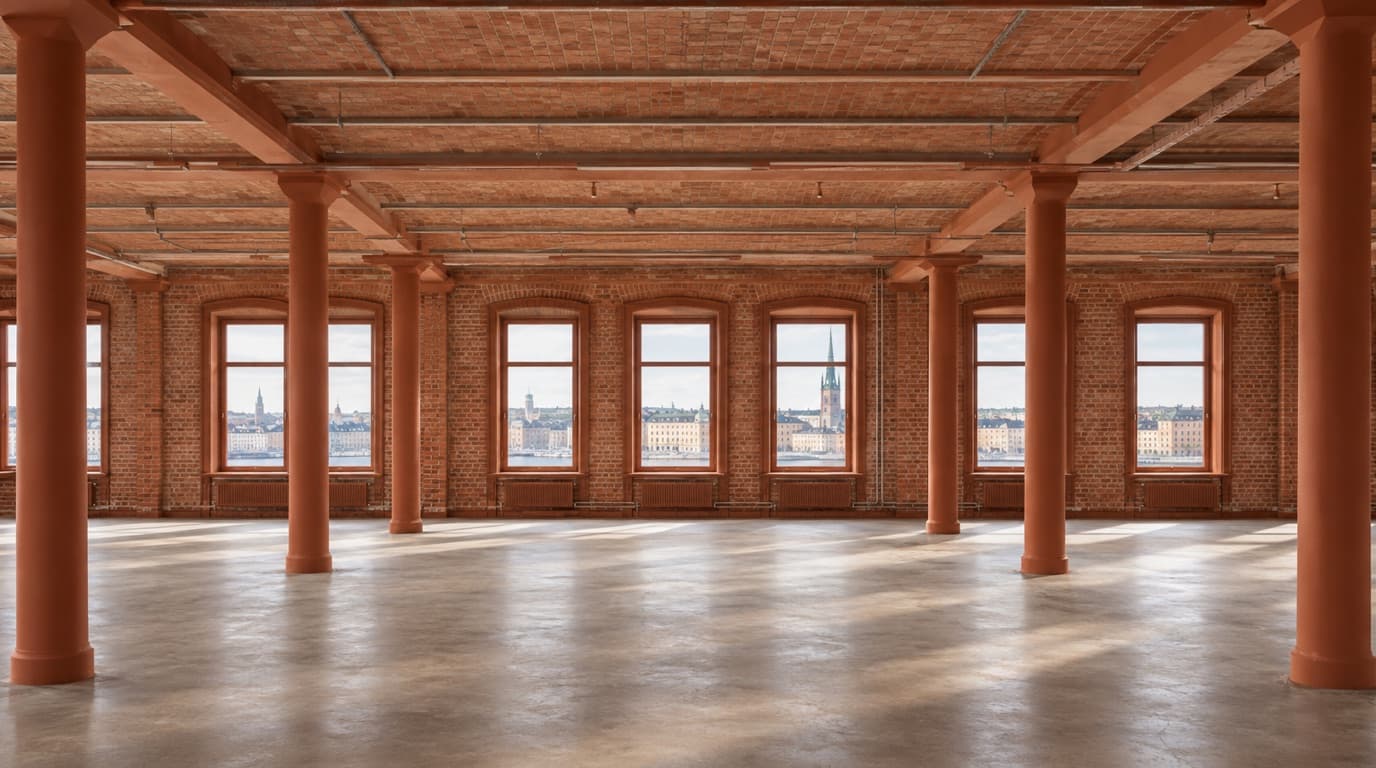
Office rents in Sweden are almost always quoted in kronor per square metre per year. That makes it important to know which square metres you are paying for. The same premises can be described by gross area, usable area or premises area, and the difference can be 10–20 percent of the floor space. So check which measure the price per square metre is based on. Here we go through what LOA, BOA, BTA and the other Swedish area terms mean, how they are measured and what to check before you sign a lease.
Short answer: Gross area (bruttoarea, BTA) is the area of all floors measured to the outside of the external walls. Usable area (bruksarea, BRA) is measured to the inside of the walls and is divided into, among others, residential area (boarea, BOA) for homes and premises area (lokalarea, LOA) for commercial space. Office rents are usually quoted per square metre of LOA. Always ask which measure applies and whether common areas are included, and ask for a drawing based on a survey of the premises.
The standard: SS 21054:2020
The Swedish area terms are defined in the Swedish standard SS 21054:2020 Area och volym för byggnader: Terminologi och mätning (Area and volume of buildings: terminology and measurement), published by the Swedish Institute for Standards, SIS. It was approved in March 2020 and replaced SS 21054:2009. According to SIS, the standard can be used for planning, building permits, taxation, valuation and rent setting, among other things.
The 2020 edition keeps the same terms as before: building area, open area, gross area, usable area, secondary area, residential area and premises area each have their own chapter. According to SIS, the main changes are clarified definitions, more illustrations, clarified rules for residential and secondary area on floors partly below ground level (souterrängvåningar), and a change in the width limit for openings from 60 to 50 centimetres.
The standard is not law. The National Board of Housing, Building and Planning, Boverket, notes in a 2023 report that several of the area terms are used in the Planning and Building Act or the Planning and Building Ordinance without being defined there, and that the measurement rules exist only in the standard, which has to be bought. In practice it is still used by municipalities, courts and property companies, and leases still state the area as LOA, BOA, BTA or BRA.
The area terms at a glance
| Term | Abbreviation | Measured to | What it covers |
|---|---|---|---|
| Bruttoarea (gross area) | BTA | Outside of external walls | All measurable floors, above and below ground, including walls |
| Bruksarea (usable area) | BRA | Inside of enclosing walls | The sum of BOA, BIA, LOA and other area |
| Boarea (residential area) | BOA | Inside | Living space in a home |
| Biarea (secondary area) | BIA | Inside | Ancillary space in a home, for example a basement, storage and a garage reached from inside |
| Lokalarea (premises area) | LOA | Inside | Space for purposes other than housing, for example offices, shops and restaurants |
| Övrig area (other area) | ÖVA | Inside | Space for running the building and general circulation |
BTA is the measure used in local development plans and building permits, where building rights are often stated as a maximum gross area. LOA describes the space a business can actually use, which is why it is the measure most often used when offices are let. The Swedish Tax Agency (Skatteverket) also states its average office rents in kronor per square metre of LOA.
What counts and what does not?
A space only counts if it is measurable under the standard. Some main rules, as described by Skatteverket and in municipal guidance:
- Ceiling height. Space with a ceiling height below 1.90 metres generally does not count. Under a sloping ceiling, you measure at most 0.60 metres beyond the line where the height is 1.90 metres.
- Stairs and shafts. Stairwells, lift openings and service shafts count on every floor, as if there were a floor there.
- Thick walls and columns. If an internal wall, column or duct is thicker than 30 centimetres, only 15 centimetres from each side counts towards usable area.
- Balconies and access galleries. Open balconies and access galleries under a roof count as open area and are not added to gross area. Fully glazed spaces, however, can be included.
In an office building, stairwells, lift lobbies and plant rooms are therefore part of BTA but not part of your LOA. In its planning guidance, the City of Gothenburg assumes that 100 square metres of BTA corresponds to roughly 83–87 square metres of LOA for offices. That is a rough planning assumption, not a rule, but it shows the difference is large enough to show up in the rent.
Rentable area and common areas
Rentable area (uthyrningsbar or uthyrbar area) is not a term of its own in SS 21054. It is a commercial measure, and what it covers is decided by the landlord and the lease. Sometimes it is the same as LOA, but in multi-tenant buildings the stated area can also include a share of space you share with others, such as the entrance, a shared kitchen, meeting rooms or toilets in the corridor. Even the older area standard from 1989 distinguished between exclusive spaces, used by one tenant, and common spaces, used by several.
That is why two offices with the same number of square metres can hold different numbers of desks. One may be entirely yours, while in the other part of the area goes to shared space. The layout matters too: columns, deep rooms without daylight and long corridors take up space that shows in the area but does not add desks. How much space you need per person is covered in the guide to office space per employee.
Worked example
The figures below are a made-up example to show the principle. Two offices are offered at SEK 3,000 per square metre per year.
| Office A | Office B | |
|---|---|---|
| Area in the lease | 400 sqm LOA, all exclusive | 400 sqm, of which 50 sqm is a share of common areas |
| Exclusive area | 400 sqm | 350 sqm |
| Annual rent | SEK 1,200,000 | SEK 1,200,000 |
| Rent per sqm of exclusive area | SEK 3,000 | about SEK 3,430 |
| Desks at 12 sqm per person (assumption) | about 33 | about 29 |
Office B may still be the better choice if the common areas are good and you avoid building your own meeting rooms. But the comparison has to be made on the same basis. More on rent levels in the overview of office prices in Stockholm.
What happens if the area in the lease is wrong?
There is little case law on incorrect areas in commercial leases. The clearest ruling concerns a home. In NJA 2002 s. 477 the lease stated 85 square metres, but the home was 77. The Supreme Court held that an area statement given without reservation was a promise the landlord was responsible for. The tenant still received neither damages nor a rent reduction, because it had not been shown that the rent would have been lower with the correct area, and the shortfall was not considered a defect giving a right to a rent reduction. In RH 2009:70 the lease stated "approx. 57 sqm" for a home of 52 square metres. The Svea Court of Appeal held that the difference was too large to fit within "approx.". Because an approximate figure still allows some variation, the tenant was awarded half of the amount claimed.
Both cases concern homes, where rent is tested against the utility value of the dwelling. For commercial premises the rent is set by the parties, and the outcome depends on what the lease says about the area and how the difference affected the rent. If the lease says "approximately" or contains a reservation, the margin is wider. If you want an exact area, write it into the lease together with how it was measured.
What to check before you sign
- Which measure. Does it say LOA, BRA, BTA or just "sqm"? Ask the landlord to state the measure in the lease.
- A documented survey. Ask for an area schedule or drawing where the premises have been measured, not just estimated.
- Which standard and when. Ask whether the area was measured under SS 21054:2020 or an older edition, and when the measurement was made. If the premises have been rebuilt since, the area may have changed.
- Common areas. Ask how much of the area is a share of shared spaces and which spaces it covers.
- Refurbishment before move-in. If the premises are rebuilt for you, ask whether the area in the lease applies before or after the works. More in the guide to tenant fit-outs.
We go through the rest of the lease terms in the checklist for renting an office.
Frequently asked questions
What does LOA mean?
Lokalarea (premises area), the usable area of spaces used for purposes other than housing, such as offices and shops. It is measured to the inside of the walls.
What is the difference between BTA and BRA?
BTA is measured to the outside of the external walls and includes the walls. BRA is measured to the inside of the enclosing walls. BTA is therefore always larger than BRA for the same building.
What is the difference between BOA and LOA?
Both are parts of usable area. BOA applies to homes and LOA to commercial premises.
Are stairwells and lifts included in LOA?
Not the building's shared stairwells and lifts. Space for running the building and general circulation counts as other area (ÖVA), not as premises area. It is, however, included in gross area.
Which standard applies to area measurement in Sweden?
SS 21054:2020 Area och volym för byggnader, which replaced SS 21054:2009.
Find the right office faster
Shace searches the whole office market for you, sends a handpicked shortlist within 24 hours and helps with viewings and the lease. Tell us what you need and we will match you with the right office.
This article is general information, not legal, tax or financial advice. Shace is not responsible for decisions made on the basis of it. Speak to a lawyer or other adviser before acting in an individual case.