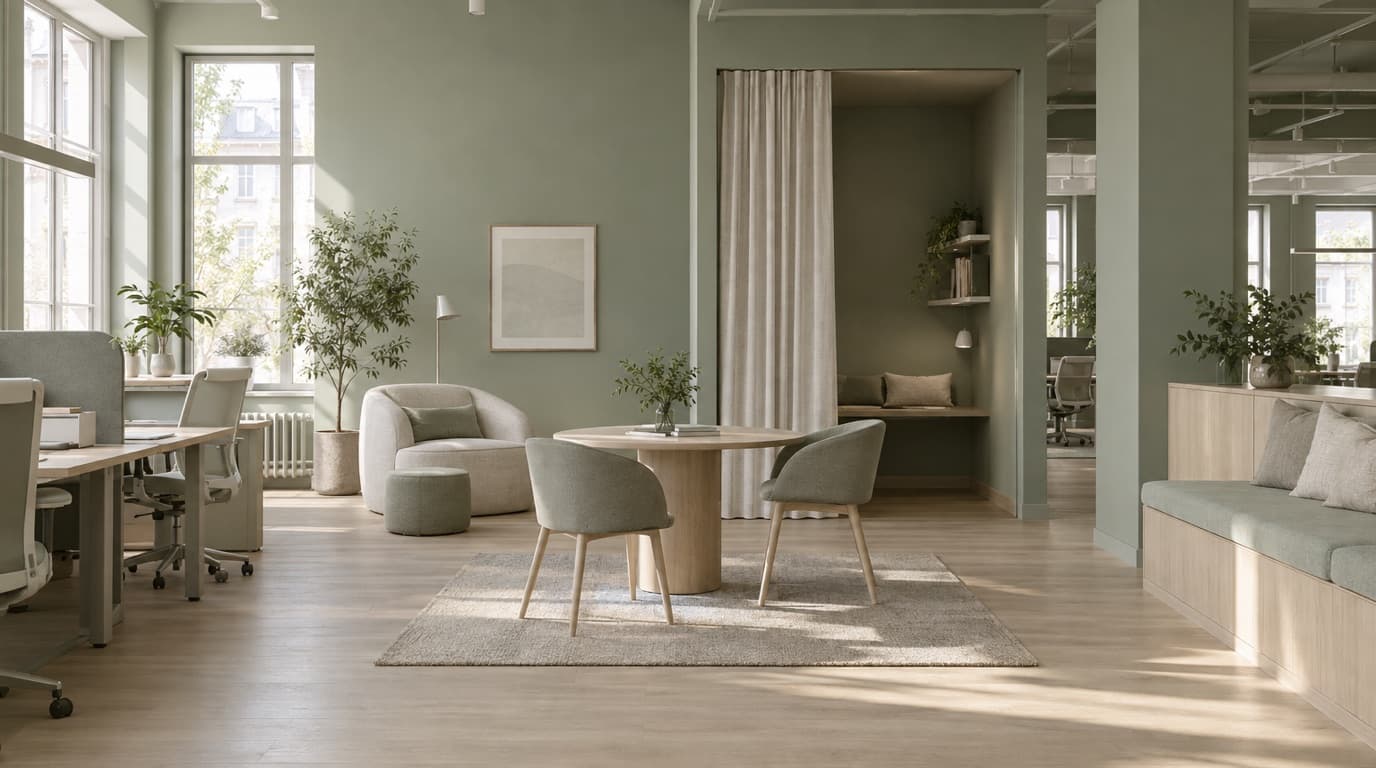
An activity-based office is an office where no one has a fixed desk. The space is divided into zones for different kinds of work, and people choose where to sit based on what they are doing at the moment. The setup has become common alongside hybrid work, but it is also one of the most debated office types. Here we go through the benefits, the drawbacks, what Swedish research actually shows and what separates the offices that work from those that do not.
Short answer: An activity-based office saves space and gives you the right setting for different tasks. The most common drawbacks are poorer concentration, disturbing noise, lack of privacy, time spent finding a place and a weaker sense of belonging. It works best for organisations with varied tasks and a lot of collaboration, and only if there are enough quiet rooms and clear ground rules.
What is an activity-based office?
Region Stockholm's Centre for Occupational and Environmental Medicine (CAMM) describes an activity-based office (aktivitetsbaserat kontor) by three traits:
- the office is divided into zones, each supporting a particular type of work
- no one has a personal desk; you sit where the task fits
- the office usually holds only about 75 percent of the workforce
Activity-based workplaces, ABW (activity-based working) and activity-based open-plan offices are often used to mean the same thing. Typical zones are:
| Zone | Used for |
|---|---|
| Quiet zone | Focused individual work, no phone calls |
| Focus rooms and phone booths | Calls, video meetings, work that needs privacy |
| Project and collaboration areas | Group work, workshops, whiteboards |
| Meeting rooms of different sizes | Booked meetings, in person and hybrid |
| Open workstations | Everyday work where some noise is fine |
| Social areas | Kitchen, lounge, spontaneous conversations |
On top of that come personal lockers, since no one can leave things on a desk.
Activity-based office, open-plan office or private offices?
| Office type | Own desk | Space per person | Best suited for |
|---|---|---|---|
| Private offices (cellkontor) | Own room | Most | Concentration, calls, confidentiality |
| Open-plan office (kontorslandskap) | Own desk in an open space | Less | Teams that work closely together |
| Activity-based office | No, zones for different tasks | Least | Varied tasks, lots of collaboration, hybrid work |
An activity-based office without enough quiet rooms and meeting rooms becomes, in practice, an open-plan office without fixed desks, with the drawbacks of both. More on the open variant in our guide to open-plan offices.
Benefits of an activity-based office
- Less space per person. Fewer desks than employees means lower rent, and that is often the main reason companies switch.
- Easier to grow or shrink. Without fixed desks you can add people or reorganise teams without rebuilding.
- More spontaneous communication. According to CAMM there is a link between activity-based offices and more spontaneous communication, especially where there are good spaces for short informal meetings.
- The right setting for the task. People who need to focus go to a quiet zone, and those collaborating sit with their team. In the University of Gävle's study of the Swedish Transport Administration (Trafikverket), those who changed workspace four or more times a day rated their productivity higher than those who stayed put.
- Managers are often satisfied. In Umeå University's study of Örnsköldsvik Municipality, 92 percent of managers wanted to stay in the new office.
Drawbacks of an activity-based office
The research is not clear-cut. The Institute of Stress Medicine (ISM) notes that there is no single truth about how activity-based offices affect the work environment. These are the drawbacks that recur in the studies.
- Harder to concentrate. Private offices support concentration best. People with a lot of focused, individual work are often the least satisfied in an activity-based office, and those coming from private offices experience more disturbance than those coming from an open-plan office.
- Disturbing noise and lack of privacy. In Örnsköldsvik these were the most common problems, and case officers and assistants wanted to go back to private offices.
- Time spent finding a place. At Trafikverket, the time it took to look for a suitable place lowered perceived productivity. An undersized office turns this into a daily source of stress.
- Many people do not move. CAMM refers to studies where about 70 percent sit in roughly the same place all day. Then you do not get the benefit of the zones.
- Weaker team feeling. When no one has a fixed place it is harder to find colleagues, and employees describe feeling more isolated.
- Harder for managers. A 2026 study from Umeå University and ISM, in which 33 managers were interviewed, shows that sensitive conversations become harder, days become more fragmented and managers feel constantly visible. One of them described it as "standing on a stage".
- Worse for those already under strain. In Örnsköldsvik, people with mental health problems and stress-related exhaustion preferred private offices.
- Ergonomics. Chair, desk and screen must be adjusted every time, and working on a laptop on sofas can cause neck and shoulder problems.
- Confidentiality. Sensitive conversations and documents need rooms where no one can hear or see.
What does the research say?
| Study | What was examined | Results |
|---|---|---|
| University of Gävle, Trafikverket (about 500 employees over three years) | Productivity after moving to an activity-based office | Four or more changes of place per day gave higher perceived productivity. Quiet rooms and quiet zones improved focused work. Time spent looking for a place lowered productivity. |
| Umeå University, Örnsköldsvik Municipality (2018) | Moving from private offices to an activity-based office | Better ventilation and IT support, but more disturbing noise, less privacy and lower perceived productivity. 92 percent of managers wanted to stay, case officers and assistants wanted to go back. |
| Chalmers, Melina Forooraghi (2022) | What makes activity-based offices healthy | Standard solutions work poorly. The office is never finished and needs to be adapted in dialogue with employees. |
| Umeå University and ISM (2026) | The manager's role, interviews with 33 managers | More stress, less overview and harder to hold sensitive conversations. All 33 described similar experiences. |
The common conclusion is that the office type itself is not what decides the outcome, but whether the office fits the work and has enough places for concentration.
Is an activity-based office right for you?
| Often works well | Often works less well |
|---|---|
| Group and project work | A lot of individual, focused work |
| Many spontaneous meetings | A lot of phone time |
| Varied tasks during the day | Similar tasks all day |
| Hybrid work with varying attendance | Confidential and sensitive material |
Do a needs analysis before you decide. Start from the work actually being done, how many people are in on a normal peak day and who needs the most privacy, not from what is fashionable.
Ground rules for an activity-based office
Without shared rules an activity-based office quickly slides back into an open-plan office where everyone has their informal spot. Draw up the rules together with employees and the health and safety representative (skyddsombud). An example:
- Quiet zone means quiet. No conversations, phone on silent.
- Calls and video meetings are taken in rooms. A phone booth or meeting room, not at a desk in the open area.
- Clean desk. Clear the desk when you leave for the day or are away for more than a couple of hours.
- No reserving. A jacket or a laptop does not hold a place.
- Book and cancel. Meeting rooms and focus rooms are booked for the time needed and cancelled if the meeting is called off.
- A home base for each team. Every team has a zone where it usually sits, so people can find each other.
- Show where you are. Use your chat status or a desk map in the booking system.
- Review the rules. Revisit them after a few months and change what does not work.
Common mistakes
- Too few quiet rooms and phone booths. The most common problem. Better too many focus rooms than too few.
- Too few places. Size for a normal peak day, not the average. We go through the calculation in our guide to office space per employee.
- The decision is driven by cost alone. An office that saves space but lowers productivity ends up expensive.
- No change management. Employees and managers need support in the new way of working, not just new furniture.
- The technology does not work everywhere. Wi-Fi, screens, docking stations and video meetings must work at every place.
- No follow-up. Adjust zones and rules once you see how the office is actually used.
Responsibility for the work environment
The employer is responsible for the work environment whatever the office type. Moving to an activity-based office is a change in the business, and under the rules on systematic work environment management (systematiskt arbetsmiljöarbete) the risks must be assessed before it happens. Involve the health and safety representative early and look especially at noise, the possibility of undisturbed work, ergonomics and how managers can hold one-to-one conversations. More on that in our article on ergonomics and the work environment at the office.
Activity-based offices and hybrid work
When people work from home one or more days a week, fixed desks stand empty and one desk per person is hard to justify. An activity-based office lets you rent less space and spend the money on what the office does best: meetings, collaboration and community.
At the same time, office days become more meeting-heavy when individual work is done at home. An activity-based office for hybrid work therefore often needs more small rooms and better video meeting equipment than one planned for full-time attendance.
How it affects the space you rent
- Fewer square metres, but a different mix. You need fewer desks but more rooms. Premises that already have several small rooms, or are easy to divide, can be worth more than a fully open floor.
- Acoustics and ventilation. Many small meeting rooms and phone booths need good sound insulation and ventilation that copes with full rooms. Ask the landlord what the building can handle.
- Tenant fit-out (hyresgästanpassning). Rebuilding for zones and rooms is a negotiation point. Who pays and how it affects the rent should be clear in the lease.
- Try it first. If you want to test the way of working before committing, a flexible office can be a first step. We compare the options in our guide to flexible offices vs traditional offices.
Frequently asked questions
What is an activity-based office?
An office where no one has a fixed desk and the space is divided into zones for different kinds of work, such as quiet rooms, phone booths, meeting rooms and collaboration areas.
What are the drawbacks of an activity-based office?
Mainly poorer concentration, disturbing noise, lack of privacy, time spent finding a place, a weaker team feeling and a harder job for managers. Most of the drawbacks can be reduced with enough quiet rooms, the right number of places and clear ground rules.
What is the difference between an open-plan office and an activity-based office?
In an open-plan office everyone has their own fixed desk in an open space. In an activity-based office no one has a fixed desk, and the space has different zones for different kinds of work.
How many workstations does an activity-based office need?
It is often planned for about 75 percent of staff, but the right level depends on how many people are in on a normal peak day. Measure attendance for a few weeks and count all types of workspace, not just desks.
Which ground rules are needed?
At minimum, rules for quiet zones, where calls are taken, clean desk, room booking and how you find each other. Draw them up together with employees and review them after a few months.
Do you save money with an activity-based office?
Often, since you need less space. But the savings can be eaten up by rebuilding, more rooms and better technology, and an undersized office costs productivity. Look at the whole picture.
Find the right office faster
Shace searches the whole office market for you, sends a handpicked shortlist within 24 hours and helps with viewings and the lease. Tell us what you need and we will match you with the right office.