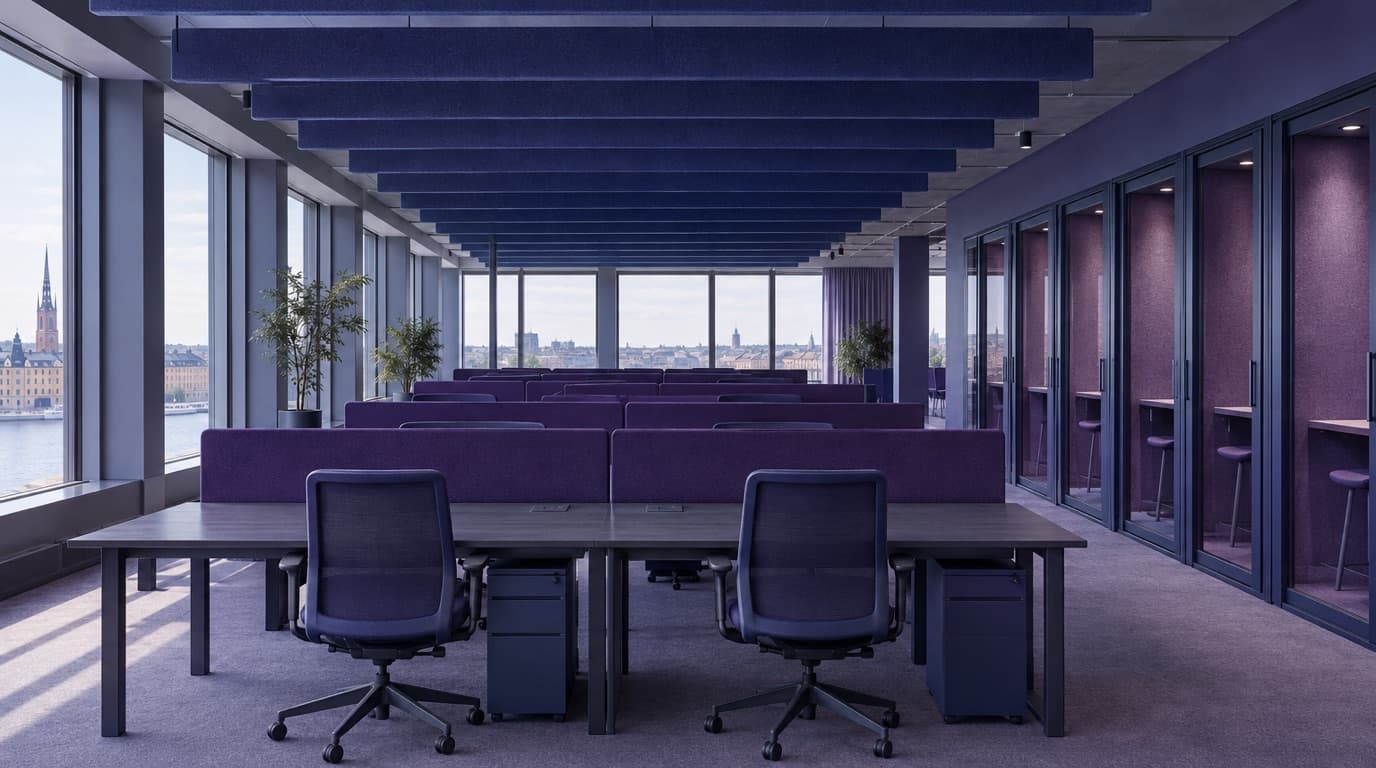
The open-plan office (kontorslandskap) is one of the most common office layouts in Sweden and also one of the most debated. An open-plan office saves space and makes collaboration easy, but many people find it hard to concentrate. Here we go through what an open-plan office is, its pros and cons, how it differs from private offices, hot-desking offices and activity-based offices, and what it takes to make an open-plan office work.
Short answer: An open-plan office is an open workspace where several people share a room with no walls between them. It needs less space per person and makes collaboration easier, but brings more noise and more interruptions. It works best with quiet rooms, enough meeting rooms, good acoustics and clear rules.
What is an open-plan office?
An open-plan office (öppet kontorslandskap) is an office where the workstations stand in a shared room instead of in separate rooms. The size varies from a room for four to six people to an entire floor. In a traditional open-plan office everyone has their own fixed desk. That distinguishes it from hot-desking offices (flexkontor) and activity-based offices, where desks are shared.
Open-plan office, private offices or something else?
| Office type | How it works | Strength | Weakness |
|---|---|---|---|
| Private offices (cellkontor) | A separate room for each person | Concentration and privacy | Needs the most space, less spontaneous collaboration |
| Open-plan office | Own desk in an open space | Space-efficient, close to colleagues | Noise and interruptions |
| Combi office (kombikontor) | Small private rooms around shared areas | Both privacy and collaboration | Expensive to build |
| Hot-desking office (flexkontor) | Open space without fixed desks | Space-efficient, fewer desks than employees | No desk of your own, requires tidiness |
| Activity-based office | Different zones for different tasks, no fixed desks | The right setting for each task | Requires a change in ways of working |
We cover activity-based offices in our guide to activity-based offices and hybrid work.
Benefits of an open-plan office
- Less space per person. More workstations fit in the same area, which lowers the rent per employee.
- Easier collaboration. Quick questions are solved on the spot and new employees settle into the group faster.
- Flexibility. It is easier to rearrange furniture when teams grow or shrink than to move walls.
- Lower fit-out costs. Fewer walls and doors make the premises cheaper to rebuild.
Drawbacks of an open-plan office
- Noise. Conversations and phone calls are the most common disturbance, especially speech you can make out.
- Interruptions. It is easier to be disturbed, and it takes time to get back into a task that requires concentration.
- Less privacy. Sensitive conversations and confidential work need dedicated rooms.
- Sick leave. Research from the Stress Research Institute at Stockholm University has linked open-plan offices to more short spells of sick leave than private offices.
How big the drawback is depends on what you do. Teams that work closely together often get more benefit than trouble from the open space, while work that requires long periods of concentration or many calls suits it less well.
How to make an open-plan office work
- Build in quiet rooms. Phone booths and focus rooms where people go for calls and focused work. Without them everything ends up in the open space.
- Invest in acoustics. Sound absorbers on ceilings and walls, textile flooring and screens between workstations make a big difference.
- Divide the space into zones. Keep talkative functions, such as sales and support, away from those who need quiet.
- Keep groups small. Several smaller open areas work better than one large one.
- Plan meeting rooms around video calls. With hybrid work more people are in video meetings, and they need rooms.
- Agree on rules. Where calls are taken, when it is fine to interrupt and how people signal that they want to be left alone.
The employer is responsible for the work environment, and noise, light and air are part of it. Involve the health and safety representative (skyddsombud) and employees early when planning a new office. More on that in our article on ergonomics and the work environment at the office.
Clean desk: when desks are shared
Clean desk means the desk is left empty at the end of the working day. It is a prerequisite for hot-desking and activity-based offices, where no one has their own desk, and is also used for security reasons so that papers and screens are not left out. For it to work you need personal lockers, the same equipment at every desk and a rule that applies to everyone, managers included.
How much space do you need?
An open-plan office needs considerably less space per person than private offices, and with shared desks even less is enough. We go through how to work out the right size for your company in our guide to office space per employee.
Frequently asked questions
What is an open-plan office?
An open workspace where several people have their workstations in the same room.
What is the difference between an open-plan office and private offices?
With private offices each person has their own room. In an open-plan office people share an open space.
What are the drawbacks of an open-plan office?
Mainly noise, interruptions and lack of privacy. They can be reduced with quiet rooms, good acoustics and clear rules.
What does clean desk mean?
That the desk should be empty when you leave it, so that someone else can use it and nothing sensitive is left out.
Which office type is best?
It depends on how you work. Most offices that work well mix open areas with rooms for calls, meetings and concentration.
Find the right office faster
Shace searches the whole office market for you, sends a handpicked shortlist within 24 hours and helps with viewings and the lease. Tell us what you need and we will match you with the right office.