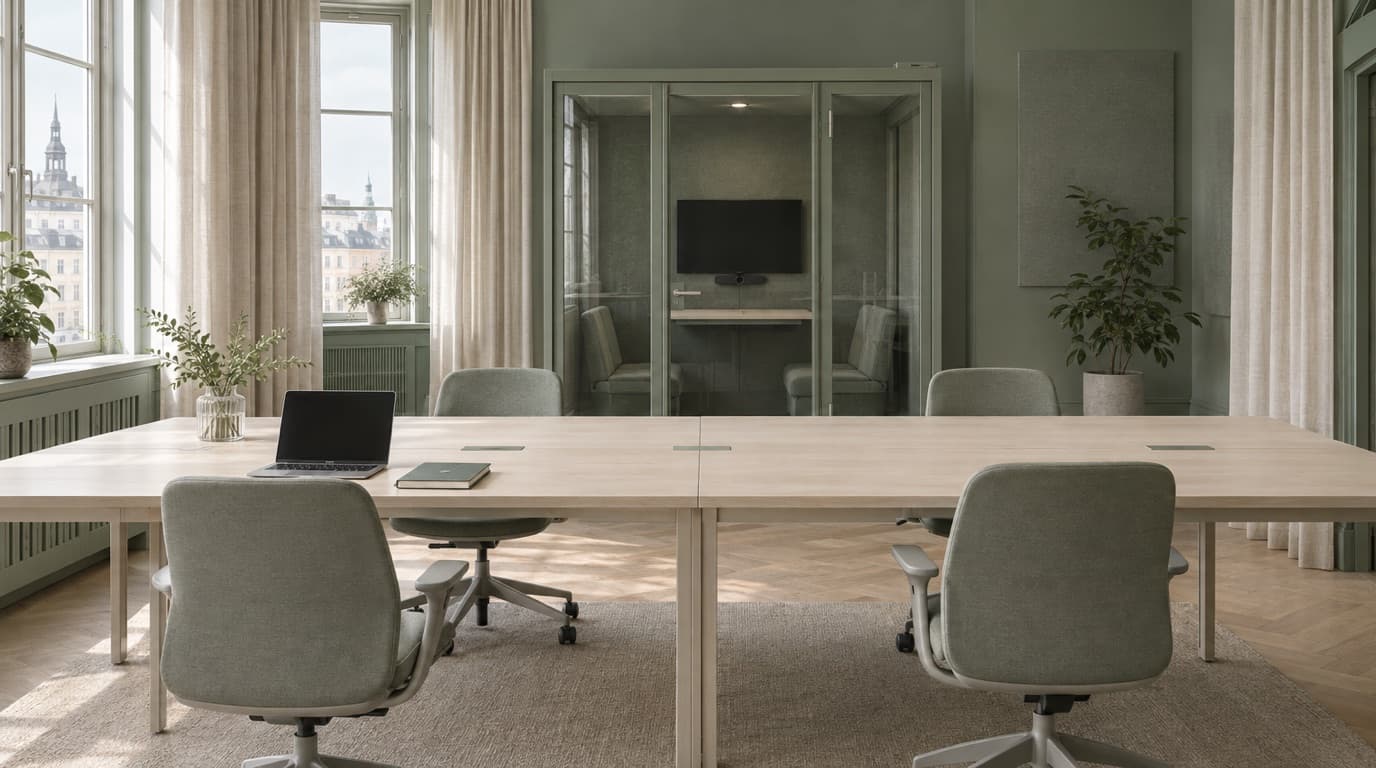
Hybrid work (hybridarbete in Swedish) means that work is split between the office and another place, such as the home. There is no standard template for how to set it up. Here we go through what hybrid work is, the models to choose from, the advantages and drawbacks, what Swedish rules say about the work environment at home, what a policy should cover and what this way of working means for the office you rent.
Short answer: Hybrid work combines work at the office with remote work. It gives employees more flexibility and can reduce the need for office space, but it calls for clearer leadership, better meeting habits and shared ground rules. In Sweden the employer is responsible for the work environment even when the work is done at home. Put what applies at your company in a written policy, so the arrangement is not decided differently by each manager.
What is hybrid work?
Hybrid work is a way of working where employees spend part of their time at the employer's office and part of it somewhere else, for example at home, at a client's premises or in a serviced office. It differs from full-time remote work, where the employee is hardly ever at the office.
A hybrid workplace is therefore a way of organising work, not a particular kind of premises. Two companies that both say they have hybrid work can mean quite different things: one has three fixed office days, the other lets each team decide for itself.
How common is hybrid work in Sweden?
Statistics Sweden (SCB) does not measure hybrid work as such, but it does measure how many people work from home. According to its Labour Force Surveys (in Swedish), around 46 percent of employed people aged 20 to 64 said they worked from home to some extent in 2024. About 13 percent worked from home at least half of their working days, compared with roughly 6 percent before the pandemic.
Working from home is most common among people with post-secondary education in private services and in central government.
What hybrid work models are there?
| Model | How it works | Often suits |
|---|---|---|
| Fixed office days | Everyone, or each team, is at the office on set days of the week | Teams that need to meet regularly and want predictability |
| Choice of office days | A set number of office days per week or month, the employee chooses which | Organisations with independent roles |
| Office first | The office is the default, working from home is possible when needed | Work that needs equipment, confidentiality or a lot of in-person collaboration |
| Remote first | Remote is the default, the office is used for meetings and team days | Teams spread across several towns |
| The team decides | The company sets the framework, each team chooses its own set-up | Larger organisations with different kinds of work |
Fixed days are the easiest to plan around, but if everyone has the same office days the office has to hold everyone at once. Looser arrangements can spread attendance better, but make it harder to know which colleagues are in.
What are the advantages of hybrid work?
For the employee
- Less commuting, and work is easier to fit around the rest of life.
- The chance to do focused work at home and collaborative work at the office.
- More say over how the working day is organised.
For the employer
- Easier recruitment, including from a wider geographical area.
- The office can be sized for the number of people who are actually in, which can lower the cost of premises.
- Office days can be used for what works best in person: meetings, onboarding new colleagues and group work.
What are the drawbacks of hybrid work?
For the employee
- The line between work and free time becomes less clear.
- A risk of loneliness and weaker contact with colleagues.
- The home is not always a good workplace, either ergonomically or for peace and quiet.
For the employer
- Harder to lead, to notice how employees are doing and to pass on the culture.
- New employees get fewer chances to learn from seeing how others work.
- In meetings where some are in the room and others join remotely, the remote participants are easily left out.
- The office can be half empty on some days and full on others.
Several of the drawbacks are about how work is organised, and can be reduced with clear ground rules. That is why a policy is needed.
Who is responsible for the work environment when people work from home?
The employer. In Sweden the responsibility for the work environment applies wherever the work is done, and according to the Swedish Work Environment Authority (Arbetsmiljöverket) it also covers remote and hybrid work. It applies both to the physical work environment, such as posture, screen and lighting, and to the organisational and social one, such as workload, availability and contact with colleagues.
In practice this means that:
- the rules on systematic work environment management (AFS 2023:1) (in Swedish) also apply to work in the home, so the risks must be investigated and assessed
- the employer needs an ongoing dialogue with employees about how working at home is going, since the workplace cannot be seen in the same way as at the office
- employees need the knowledge to spot shortcomings themselves, for example in ergonomics, and must take part in the work environment management
- if a good work environment cannot be arranged at home, the employer can have the work done at a place the employer equips, for example the office.
Involve the safety representative (skyddsombud) when you set up or change the way of working.
What should a hybrid work policy cover?
A policy does not need to be long, but it should answer the questions that would otherwise be decided differently by each manager.
- Who is covered. Which roles suit hybrid working and which need to be in the office.
- Attendance. How many days at the office, who decides which ones and whether the team has shared days.
- Availability. Working hours, when people are expected to respond and how they show where they are.
- Meetings. When meetings should be held in person, and how hybrid meetings should work so that everyone is heard.
- Work environment and equipment. What the employer provides at home, how conditions at the home workspace are reviewed and who the employee turns to.
- Information security. What applies to sensitive conversations, documents and work in places other than the home.
- Work from another town or abroad. What needs approval in advance.
- Review. When the policy will be reviewed, for example after six months.
Draw it up together with employees and the safety representative, which makes it easier to follow.
How does hybrid work affect the office?
Hybrid work changes what the office is used for, and with it the premises you need.
- Size. When not everyone is in at the same time, fewer desks than employees may be enough. Plan for the day when most people are usually in, not the average. The method is in our guide to office space per employee.
- Layout. If office days fill up with meetings and video calls, you need more small rooms and fewer fixed desks. That can be an activity-based office or an open-plan office with more meeting rooms and phone booths.
- Location. If the office is to be worth the journey, travel time matters more. A location close to the metro, commuter trains or the central station makes it easier to get people in.
- Lease. If you are unsure how attendance will develop, a shorter lease or a flexible office can be a way to avoid committing to too much space. We compare the options in our guide to flexible offices vs traditional offices.
Frequently asked questions
What is hybrid work?
A way of working where work is split between the employer's office and another place, such as the home. The split between office and home varies between companies and teams.
What is the difference between hybrid work and remote work?
Remote work is work done somewhere other than the employer's office. Hybrid work is a mix, where part of the work is done at the office and part remotely.
How many office days are common in hybrid work?
There is no norm. The right level depends on how much of the work requires you to meet, and it can differ between teams.
Who is responsible for the desk and chair when working from home?
According to the Swedish Work Environment Authority, the employer is responsible for the work environment even when people work from home, and needs to find out, in dialogue with the employee, whether the screen, desk and chair work. If a good workspace cannot be arranged at home, the employer can have the work done at a place the employer has equipped, such as the office. Who pays for what should be set out in your policy.
Do we need a smaller office with hybrid work?
Not necessarily. You may need fewer desks but more meeting rooms and rooms for video calls. Measure attendance for a few weeks before you decide on a size.
Find the right office faster
Shace searches the whole office market for you, sends a handpicked shortlist within 24 hours and helps with viewings and the lease. Tell us what you need and we will match you with the right office.
This article is general information, not legal, tax or financial advice. Shace is not responsible for decisions made on the basis of it. Speak to a lawyer or other adviser before acting in an individual case.